
KPV: A Research Overview
KPV is the C-terminal tripeptide of α-MSH (Lys-Pro-Val). This overview traces its origin as a cleaved melanocortin fragment, the receptor-independent pharmacology reported in the literature, and its regulatory classification. Educational reference.

For research use only. Not for human consumption. This article is educational reference material. It is not medical advice and is not a recommendation to use any substance.
KPV: A Research Overview
KPV is a tripeptide of lysine, proline, and valine that corresponds to the carboxy-terminal three residues of α-melanocyte-stimulating hormone (α-MSH). Among peptides derived from the melanocortin system, it is unusual: it is one of the smallest fragments reported to retain a distinct anti-inflammatory profile in preclinical models, yet it does so without the receptor engagement that defines its parent molecule. That combination (minimal sequence, separable activity, receptor-independent pharmacology) is why KPV has been studied less as a drug candidate and more as a structural probe of how short neuropeptide fragments carry and reassign biological signals. This overview traces KPV's identity, its origin within α-MSH, the pharmacological puzzle that distinguishes it, and its regulatory classification, drawing on published primary literature.
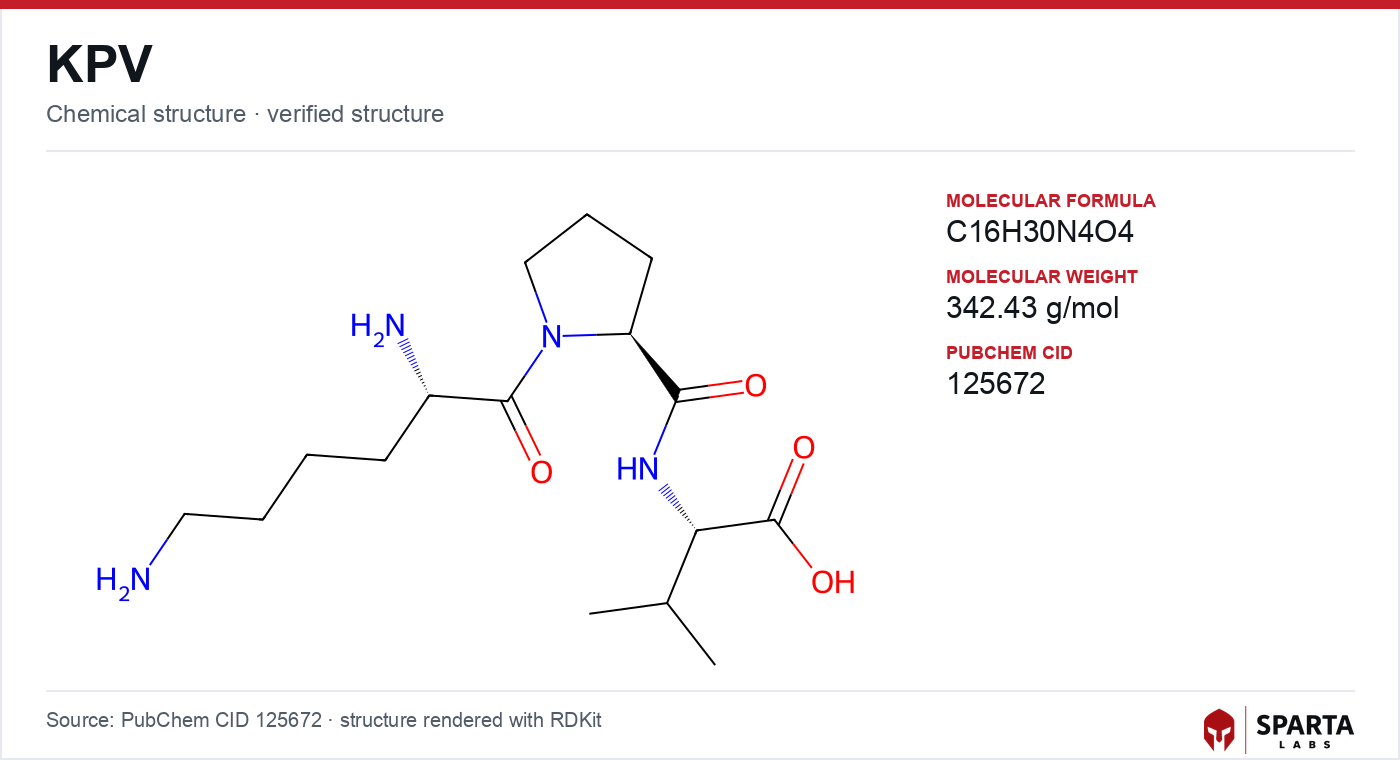
Figure: chemical structure of KPV.
A Fragment Cut From α-MSH
α-MSH is a 13-amino-acid neuropeptide processed from the precursor protein proopiomelanocortin (POMC) in the pituitary and in peripheral tissues. Its canonical structure carries an N-terminal acetyl group and a C-terminal amide: Ac-Ser-Tyr-Ser-Met-Glu-His-Phe-Arg-Trp-Gly-Lys-Pro-Val-NH₂. The residues that drive melanocortin receptor binding cluster in the core of the molecule, around the His-Phe-Arg-Trp motif. The final three residues, positions 11 through 13, form the Lys-Pro-Val sequence at the opposite, C-terminal end.
Catania and Lipton established in a 1993 review that α-MSH modulates host defense reactions across multiple inflammatory models [1]. As investigators dissected which regions of the peptide accounted for which activities, the C-terminal domain emerged as carrying an anti-inflammatory character that was pharmacologically separable from the central pharmacophore. This observation is the reason KPV became a research entity in its own right rather than remaining an incidental fragment: the tail of the molecule appeared to do work independent of the part that binds the receptor.
Chemistry and the Role of Each Residue
In its research form, KPV is most often the N-acetylated, C-terminally amidated tripeptide, written Ac-KPV-NH₂ (Ac-Lys-Pro-Val-NH₂). A mass spectrometric characterization of this acetylated amide form reported a calculated (M+H)⁺ of 384.26 [2]. The blocked termini mirror the acetyl and amide caps of the parent α-MSH, and each of the three residues contributes a distinct property that has been noted in structural studies.
Lysine provides a primary ε-amine on its side chain, which structural-modification work has identified as a reactive handle for chemical derivatization; Songok and colleagues, for example, described a reductive alkylation of the lysine residue to probe how modification affects the peptide [2]. Proline imposes conformational rigidity through its pyrrolidine ring, constraining the backbone. Valine contributes a branched hydrophobic terminus.
A conformational analysis of Ac-Lys-Pro-Val-NH₂ published in the Journal of Pharmacy and Pharmacology in 2001 characterized the solution geometry of the tripeptide and reported that the proline residue induces a bent backbone conformation, a feature the authors related to how the molecule may present itself to biological targets [3]. Because the KPV sequence is short and proline-constrained, its shape is comparatively well defined, which is part of what makes it tractable as a research probe.
The Receptor-Independent Puzzle
The melanocortin peptide family signals through five G protein-coupled receptor subtypes, MC1R through MC5R. Full-length α-MSH engages MC1R and MC3R with the greatest relevance in immunomodulatory contexts. KPV is notable precisely because it appears to sidestep this machinery. In a 2007 review, Luger and Brzoska observed that KPV "seems not to bind to MC-1R and fails to increase cyclic adenosine monophosphate (cAMP) levels" [4], the second messenger that classical melanocortin receptor activation elevates. If KPV neither binds the receptor nor raises cAMP, then whatever activity it retains must run through a different route.
This distinguishes KPV from other melanocortin-derived peptides in the same research cluster, such as the synthetic analog Melanotan-2, which was engineered to retain and extend high-affinity melanocortin receptor agonism. Where Melanotan-2 amplifies the classical pathway, KPV is studied as a tool for interrogating non-classical, receptor-independent effects downstream of the melanocortin system.
Two lines of inquiry have shaped how researchers frame that receptor-independent behavior. First, published work has associated KPV's reported anti-inflammatory activity with interference in NF-κB nuclear translocation rather than with a surface receptor; Land examined melanocortin-related peptides in human bronchial epithelial cells and discussed KPV's action in this context [5]. Findings from research models do not establish safety or efficacy in humans. Sparta Labs makes no claims about the use of this compound. Second, the KPV sequence bears a structural resemblance to the C-terminal tripeptide of interleukin-1β, prompting hypotheses that KPV may interact with elements of the IL-1 signaling axis [4]. These pathway-level questions are examined in detail in the KPV mechanism of action article.
Pharmacological Classification
Taken together, these properties place KPV in an unusual classificatory position. It is a melanocortin-derived peptide by lineage, yet it is not a melanocortin receptor agonist by function. It is most accurately described in the literature as a small anti-inflammatory α-MSH fragment whose activity is reported through receptor-independent, intracellular pathways. This is a meaningfully different profile from that of a growth-hormone secretagogue, a GLP-1 agonist, or a classical melanocortin agonist, and it is the reason KPV is grouped with immunomodulatory research peptides rather than with hormone-mimetic classes.
The distinction matters for how the compound is studied. Because KPV does not depend on receptor occupancy, its research questions center on cellular uptake, intracellular targets, and transcription-factor signaling rather than on binding affinity and dose-response at a receptor. The body of published studies that address those questions is summarized in the KPV published research article.
Regulatory Status
KPV is not approved by the United States Food and Drug Administration for any therapeutic indication. No IND filing or NDA for KPV as a drug substance is referenced in publicly available FDA databases, and the published literature on the molecule derives from in vitro and preclinical research settings. It is therefore classified and handled as a research compound.
The broader melanocortin research program has nonetheless produced approved pharmaceutical products for other targets. Bremelanotide (Vyleesi), an MC4R agonist, received FDA approval in 2019 for an unrelated indication. That approval illustrates the translational reach of melanocortin chemistry as a whole, but it does not extend to KPV, whose distinct receptor-independent profile has not been the subject of an approved application. Researchers evaluating material for laboratory work can review the analytical and purity considerations in the KPV sourcing and quality article, or view research-grade KPV from Sparta Labs.
How KPV Came to Be Studied on Its Own
The anti-inflammatory properties of α-MSH were reported as early as 1986, when Cannon and colleagues published findings that α-MSH inhibited immunostimulatory and inflammatory actions of interleukin-1 in vitro and in vivo [6]. Through the 1990s, investigators mapped which regions of the α-MSH sequence carried which activities, and Lipton and Catania's 1997 review in Immunology Today formalized the peptide's classification as a neuroimmunomodulator [7].
The specific identification of KPV as a pharmacologically distinct fragment was crystallized in a 2003 study by Getting, Schiöth, and Perretti, which dissected the contributions of the core pharmacophore versus the C-terminal KPV sequence in a peritonitis model [8]. That work provided foundational evidence that the anti-inflammatory profile of the C-terminal fragment was mechanistically separable from canonical melanocortin receptor agonism, the finding that turned a piece of α-MSH into a subject of independent investigation. Subsequent work through the 2010s deepened the mechanistic picture and explored delivery and uptake questions, extending the research lineage that this overview introduces.
References
-
Catania A, Lipton JM. Alpha-melanocyte stimulating hormone in the modulation of host reactions. Endocr Rev. 1993;14(5):564-576. PMID: 8262006. DOI: 10.1210/edrv-14-5-564. PubMed
-
Songok AC, Panta P, Doerrler WT, Macnaughtan MA, Taylor CM. Structural modification of the tripeptide KPV by reductive "glycoalkylation" of the lysine residue. PLoS One. 2018;13(6):e0199686. PMID: 29953505. DOI: 10.1371/journal.pone.0199686. PubMed
-
Chavatte P, Yous S, Lesieur D, Hénichart JP. Conformational analysis of tripeptide Ac-Lys-Pro-Val-NH2, COOH-terminal sequence of alpha-MSH. J Pharm Pharmacol. 2001;53(7):949-953. PMID: 11480545. DOI: 10.1211/0022357011776360. PubMed
-
Luger TA, Brzoska T. Alpha-MSH related peptides: a new class of anti-inflammatory and immunomodulating drugs. Ann Rheum Dis. 2007;66(Suppl 3):iii52-iii55. PMID: 17934097. DOI: 10.1136/ard.2007.079780. PubMed
-
Land SC. Inhibition of cellular and systemic inflammation cues in human bronchial epithelial cells by melanocortin-related peptides: mechanism of KPV action and a role for MC3R agonists. Int J Physiol Pathophysiol Pharmacol. 2012;4(2):59-73. PMID: 22837805. PubMed
-
Cannon JG, Tatro JB, Reichlin S, Dinarello CA. Alpha melanocyte stimulating hormone inhibits immunostimulatory and inflammatory actions of interleukin 1. J Immunol. 1986;137(7):2232-2236. PMID: 3489761. PubMed
-
Lipton JM, Catania A. Anti-inflammatory actions of the neuroimmunomodulator alpha-MSH. Immunol Today. 1997;18(3):140-145. PMID: 9078687. DOI: 10.1016/s0167-5699(97)01009-8. PubMed
-
Getting SJ, Schiöth HB, Perretti M. Dissection of the anti-inflammatory effect of the core and C-terminal (KPV) alpha-melanocyte-stimulating hormone peptides. J Pharmacol Exp Ther. 2003;306(2):631-637. PMID: 12750433. DOI: 10.1124/jpet.103.051623. PubMed
Disclaimer. Statements in this article have not been evaluated by the Food and Drug Administration. This compound is not intended to diagnose, treat, cure, or prevent any disease. Sparta Labs sells research-use-only materials. Content is provided for educational and informational purposes only and does not constitute medical advice. Consult a qualified medical professional for any health concerns.
Frequently asked questions
What is KPV peptide?
KPV is a synthetic tripeptide made of three amino acids: lysine, proline, and valine (Lys-Pro-Val). It is the C-terminal fragment of alpha-melanocyte-stimulating hormone (alpha-MSH), a naturally occurring signaling peptide. KPV is a research-use-only compound examined in laboratory and preclinical studies.
What is KPV?
KPV refers to a short peptide consisting of the three-amino-acid sequence lysine-proline-valine. It derives from the terminal end of the alpha-MSH molecule and is studied as a research chemical. It is not approved for human use and is designated for research purposes only.
What does KPV peptide do?
In published preclinical research, KPV has been studied for its interaction with cellular signaling pathways as a fragment of alpha-MSH. Investigators have examined its behavior in cell-culture and animal models. These are research observations only; KPV is not established to have any effect in humans.
What does KPV do in research studies?
Laboratory research has investigated KPV primarily in in-vitro and animal models exploring the biology of the alpha-MSH peptide family. Reported findings are limited to experimental settings and have not been evaluated in humans. Sparta Labs makes no claims about KPV's effects.
Is KPV FDA approved?
No. KPV is not approved by the U.S. Food and Drug Administration for any human use, and it is not an approved drug or dietary supplement. It is sold as a research-use-only material intended for laboratory investigation, not for human consumption.
What is the KPV peptide made of?
The KPV peptide is composed of three amino acid residues: lysine (K), proline (P), and valine (V). This tripeptide sequence represents the C-terminal portion of alpha-melanocyte-stimulating hormone (alpha-MSH), the parent molecule from which KPV is derived.