
MOTS-c: A Research Overview
MOTS-c is a 16-residue peptide translated from a short open reading frame inside the mitochondrial 12S rRNA gene, and one of the first identified members of the mitochondrial-derived peptide class. Educational reference.

For research use only. Not for human consumption. This article is educational reference material. It is not medical advice and is not a recommendation to use any substance.
Introduction
MOTS-c (mitochondrial open reading frame of the twelve-S rRNA type-c) is a 16-amino-acid peptide whose coding sequence lies inside the mitochondrial genome rather than the nucleus. It is one of the first characterized members of a small family known as mitochondrial-derived peptides (MDPs). Lee and colleagues reported the peptide in a 2015 paper in Cell Metabolism, describing a short open reading frame within the mitochondrial 12S ribosomal RNA gene whose translated product could be detected in tissue and circulation [1]. What makes MOTS-c a distinctive object of study is not a single reported activity but its genomic address: a bioactive peptide read out of an organelle that most textbooks describe as encoding only respiratory-chain subunits, ribosomal RNAs, and transfer RNAs.
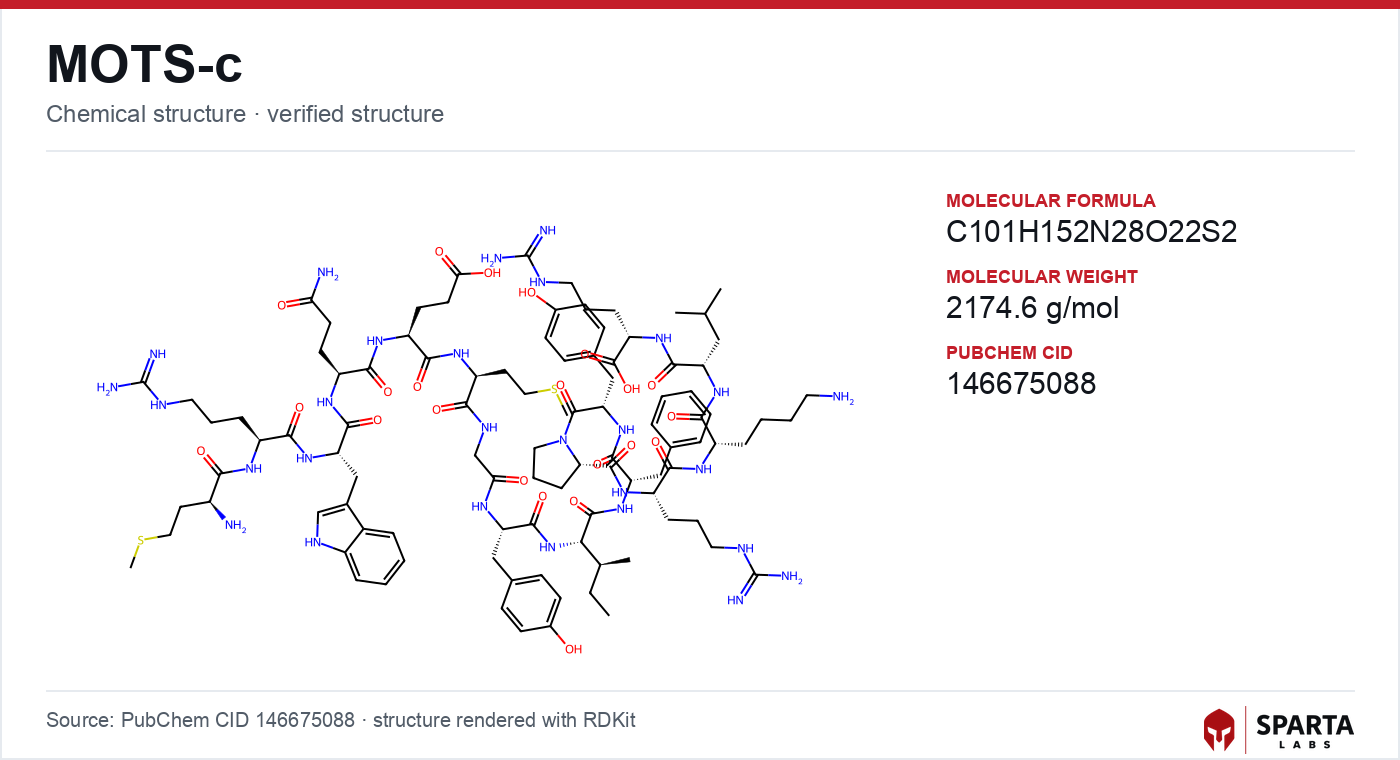
Figure: chemical structure of MOTS-c.
A peptide read out of the mitochondrial genome
The human mitochondrial genome (mtDNA) is a circular, double-stranded molecule of roughly 16,569 base pairs. Its recognized content is compact: 13 polypeptides that form part of the oxidative-phosphorylation machinery, two ribosomal RNAs (16S and 12S), and 22 transfer RNAs. For most of the post-sequencing era, the two rRNA genes were treated as structural RNA only. The identification of humanin within the 16S (MT-RNR2) region, first described in 2001 in work on neuronal cell death, was the initial signal that these regions harbor additional coding potential [2].
MOTS-c extended that picture into the 12S (MT-RNR1) gene. Its 75-base-pair open reading frame sits within sequence that also functions as ribosomal RNA, so the same stretch of mtDNA carries two distinct types of genetic information. This overlap is part of why MDP discovery relied on combined bioinformatic and mass-spectrometry approaches rather than classical gene annotation. The MDP concept has since been used to frame a broader set of small peptides derived from the mitochondrial genome, of which MOTS-c and humanin remain the most studied.
Findings from research models do not establish safety or efficacy in humans. Sparta Labs makes no claims about the use of this compound.
Sequence, structure, and conservation
MOTS-c has the sequence Met-Arg-Trp-Gln-Glu-Met-Gly-Tyr-Ile-Phe-Tyr-Pro-Arg-Lys-Leu-Arg (MRWQEMGYIFYPRKLR). Its molecular formula is approximately C₁₀₁H₁₅₂N₂₈O₂₂S₂, giving a molar mass near 2,174 g/mol. The molecule carries two methionine residues and a basic C-terminal cluster (Arg-Lys-Leu-Arg) that gives the peptide a net positive charge at physiological pH.
Comparative analysis reported in the discovery work indicated that the N-terminal portion of the sequence is conserved across multiple mammalian species, a pattern consistent with functional constraint on that region [1]. The basic C-terminal motif has been discussed in later work in the context of intracellular trafficking, including nuclear localization under stress conditions [3]. A practical consequence of the two methionine and multiple aromatic residues is that MOTS-c is a reasonable target for analytical characterization by reversed-phase HPLC and mass spectrometry, which is relevant to how research-grade material is verified; that analytical dimension is discussed in the MOTS-c published research summary.
Non-canonical translation and codon usage
One of the more technically interesting features of MOTS-c concerns how it is made. The mitochondrial genetic code differs from the standard code at several codons, and mitochondrial ribosomes translate the respiratory-chain subunits inside the organelle. MOTS-c, however, has been discussed in the literature as being encoded by an open reading frame that is read according to the cytoplasmic (standard) genetic code, implying translation outside the mitochondrial matrix after the transcript exits the organelle. This detail matters for interpretation: the amino acid sequence assigned to MOTS-c depends on which genetic code is applied to the underlying DNA, and the discovery work addressed this by directly detecting the peptide rather than inferring it from sequence alone [1]. The specifics of where and how the peptide is translated remain an area of continued investigation, and readers focused on the signaling machinery may prefer the MOTS-c mechanism of action article.
Pharmacological classification
Within peptide pharmacology, MOTS-c is categorized as a mitochondrial-derived peptide with reported intracellular and intercellular signaling associations. The 2015 discovery paper characterized MOTS-c in relation to AMP-activated protein kinase (AMPK) signaling, a central cellular energy-sensing pathway, via an indirect route involving the folate–methionine cycle and accumulation of the endogenous AMPK ligand AICAR [1]. A 2018 study in Cell Metabolism described conditions under which MOTS-c can translocate to the nucleus and associate with regulation of stress-responsive gene expression [3].
This combination of a cytoplasmic metabolic association and a described nuclear localization is what distinguishes MOTS-c from a simple secreted signaling peptide and is why it is often discussed as a candidate mitochondrial-to-nuclear communication molecule. Because its classification centers on the AMPK axis, the World Anti-Doping Agency added MOTS-c to its Prohibited List within the metabolic-modulators category (AMPK-activator subcategory), effective at all times for athletes subject to WADA rules. Researchers surveying mitochondrial peptide biology frequently place MOTS-c alongside other mitochondrion-associated compounds; the SS-31 (Elamipretide) research overview and the NAD+ research overview provide parallel reference points for adjacent areas of mitochondrial and cellular-energy research.
Human genetic variation
Unlike many synthetic research peptides, MOTS-c corresponds to an endogenous sequence subject to inherited variation. Population-genetics work described the mitochondrial variant m.1382A>C, which alters residue 14 of the MOTS-c peptide (a lysine-to-glutamine change) and occurs at appreciable frequency in some Northeast Asian populations, including Japanese cohorts [4]. Investigators reported statistical associations between this variant and metabolic phenotypes within the studied populations. This line of work is notable because it grounds MOTS-c in human genetics rather than solely in cell-culture and rodent models, and it illustrates that the "reference" MOTS-c sequence is one allele among naturally occurring variants. Additional work has examined MOTS-c as an exercise-responsive, mitochondrially encoded factor in the context of muscle biology and aging [5].
Regulatory status
MOTS-c is not approved by the US Food and Drug Administration (FDA) for any therapeutic indication. No New Drug Application (NDA) or Biologics License Application (BLA) for MOTS-c as a pharmaceutical product appears in publicly available FDA databases as of this article's date. The compound sits in a research-use-only category consistent with its stage of scientific development, characterized by active preclinical study, human observational and genetic analyses, and an evolving mechanistic literature. Laboratories sourcing the peptide for characterization studies can review the corresponding MOTS-c research peptide listing for specification details.
References
-
Lee C, Zeng J, Drew BG, Sallam T, Martin-Montalvo A, Wan J, Kim SJ, Mehta H, Hevener AL, de Cabo R, Cohen P. The mitochondrial-derived peptide MOTS-c promotes metabolic homeostasis and reduces obesity and insulin resistance. Cell Metab. 2015 Mar 3;21(3):443–454. doi: 10.1016/j.cmet.2015.02.009. PMID: 25738459. https://pubmed.ncbi.nlm.nih.gov/25738459/
-
Hashimoto Y, Niikura T, Tajima H, Yasukawa T, Sudo H, Ito Y, Kita Y, Kawasumi M, Kouyama K, Doyu M, Sobue G, Koide T, Tsuji S, Lang J, Kurokawa K, Nishimoto I. A rescue factor abolishing neuronal cell death by a wide spectrum of familial Alzheimer's disease genes and Abeta. Proc Natl Acad Sci U S A. 2001 May 22;98(11):6336–6341. doi: 10.1073/pnas.101133498. PMID: 11371646. https://pubmed.ncbi.nlm.nih.gov/11371646/
-
Kim KH, Son JM, Benayoun BA, Lee C. The mitochondrial-encoded peptide MOTS-c translocates to the nucleus to regulate nuclear gene expression in response to metabolic stress. Cell Metab. 2018 Sep 4;28(3):516–524.e7. doi: 10.1016/j.cmet.2018.06.015. PMID: 29983246. https://pubmed.ncbi.nlm.nih.gov/29983246/
-
Zempo H, Kim SJ, Fuku N, Nishida Y, Higaki Y, Wan J, Yen K, Miller B, Vicinanza R, Miyamoto-Mikami E, Kumagai H, Naito H, Xiao J, Mehta HH, Lee C, Hara M, Patel HN, Setiawan VW, Moore TM, Hevener AL, Sutoh Y, Shimizu A, Kojima K, Kinoshita K, Tanaka K, Cohen P. A pro-diabetogenic mtDNA polymorphism in the mitochondrial-derived peptide, MOTS-c. Aging (Albany NY). 2021 Jan 25;13(2):1692–1717. doi: 10.18632/aging.202529. PMID: 33468709. https://pubmed.ncbi.nlm.nih.gov/33468709/
-
Reynolds JC, Lai RW, Woodhead JST, Joly JH, Mitchell CJ, Cameron-Smith D, Lu R, Cohen P, Graham NA, Benayoun BA, Merry TL, Lee C. MOTS-c is an exercise-induced mitochondrial-encoded regulator of age-dependent physical decline and muscle homeostasis. Nat Commun. 2021 Jan 20;12(1):470. doi: 10.1038/s41467-020-20790-0. PMID: 33473109. https://pubmed.ncbi.nlm.nih.gov/33473109/
-
Wan W, Zhang L, Lin Y, Rao X, Wang X, Hua F, Ying J. Mitochondria-derived peptide MOTS-c: effects and mechanisms related to stress, metabolism and aging. J Transl Med. 2023 Jan 20;21(1):36. doi: 10.1186/s12967-023-03885-2. PMID: 36670507. https://pubmed.ncbi.nlm.nih.gov/36670507/
Disclaimer. Statements in this article have not been evaluated by the Food and Drug Administration. This compound is not intended to diagnose, treat, cure, or prevent any disease. Sparta Labs sells research-use-only materials. Content is provided for educational and informational purposes only and does not constitute medical advice. Consult a qualified medical professional for any health concerns.
Frequently asked questions
What is MOTS-c?
MOTS-c is a mitochondrial-derived peptide, a 16-amino-acid peptide encoded within the mitochondrial 12S ribosomal RNA gene rather than the cell nucleus. It was first reported in the scientific literature in 2015 and is used strictly as a research-use-only compound in laboratory settings.
What is MOTS-c peptide?
MOTS-c peptide is a short 16-amino-acid sequence classified as a mitochondrial-derived peptide (MDP), one of a small family of peptides encoded by mitochondrial DNA. Published research describes it as a compound of interest in cellular and metabolic biology studies, and it is offered for research use only.
What does MOTS-c do?
In published laboratory and animal research, MOTS-c has been studied for its reported role in cellular metabolic signaling. Studies (Lee et al., 2015, Cell Metabolism) described its association with the AMPK pathway in cell and rodent models. These are research observations only and do not establish any effect in humans.
What does MOTS-c peptide do in research?
Research literature reports MOTS-c as a mitochondrial-derived peptide investigated for how mitochondria may communicate with the rest of the cell. Cited studies have examined its interaction with metabolic signaling pathways in vitro and in animal models. Findings from these research models do not establish safety or efficacy in humans.
What is MOTS-c used for in research?
MOTS-c is used as an investigational compound in laboratory and preclinical research studying mitochondrial-derived peptides and cellular metabolism. Its documented use is confined to cell-culture and animal-model studies published in the scientific literature. Sparta Labs supplies MOTS-c for research use only and makes no claims about human use.
Is MOTS-c FDA approved?
No. MOTS-c is not approved by the FDA for any human use and is not an approved drug or dietary supplement. It is classified as a research-use-only compound intended for laboratory investigation, not for human consumption, diagnosis, or treatment of any condition.