
DSIP (Delta Sleep-Inducing Peptide): Discovery and Regulatory History
A documented account of the discovery of delta sleep-inducing peptide (DSIP): the 1977 Basel isolation, the sequencing of the nonapeptide, early human sleep studies, and the compound's regulatory history. Educational reference.

For research use only. Not for human consumption. This article is educational reference material. It is not medical advice and is not a recommendation to use any substance.
Introduction
Delta sleep-inducing peptide (DSIP) is a nonapeptide first isolated in the 1970s during a search for endogenous factors associated with slow-wave sleep. The name reflects the experimental observation that gave rise to the compound: a peptide fraction associated with enhancement of the delta-frequency electroencephalogram (EEG), the electrical signature of deep, slow-wave sleep. The history of DSIP is unusual within neuropeptide research because, nearly five decades after its isolation, the compound's status as a genuine endogenous signaling molecule, its gene, and its receptor remain incompletely resolved in the published literature [7]. A broader account of the compound's chemistry and classification is available in the DSIP research overview.
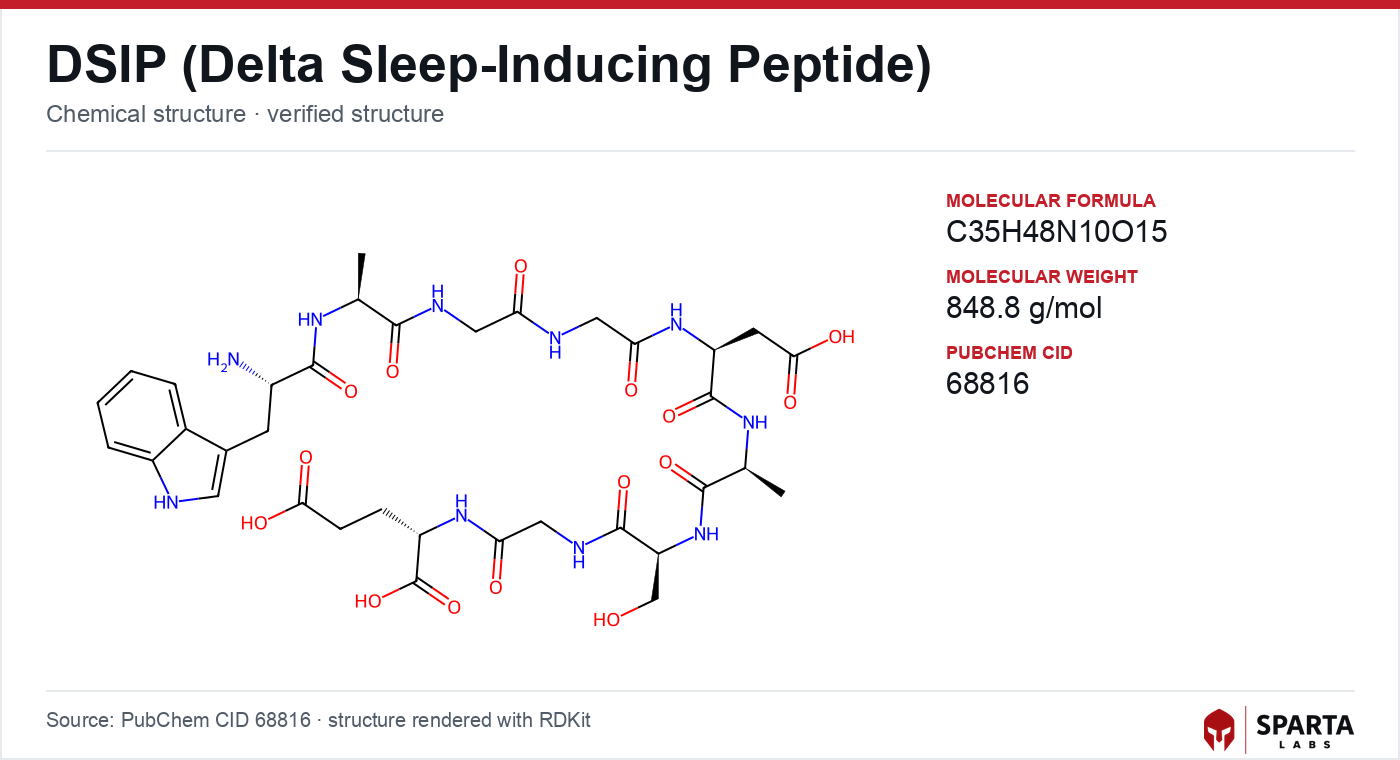
Figure: chemical structure of DSIP.
Discovery Period: The Basel Sleep-Factor Program (1970s)
The experimental program that produced DSIP was conducted at the University of Basel in Switzerland by a group led by Guido A. Schoenenberger and Marcel Monnier. The work built on the older "humoral" hypothesis of sleep, which proposed that sleep-associated states might be mediated by transferable chemical factors circulating in the blood or cerebrospinal fluid.
The Basel group's approach was procedurally distinctive. Investigators induced a slow-wave (delta) EEG state in donor rabbits through low-frequency electrical stimulation of thalamic structures, then collected and dialyzed the cerebral venous blood from those animals. From that dialysate they purified a peptide fraction that, when administered to recipient rabbits, was reported to be associated with reproduction of the delta EEG pattern. The characterization of this "delta-electroencephalogram (-sleep)-inducing peptide" was reported by Schoenenberger and Monnier in the Proceedings of the National Academy of Sciences in 1977 [1].
Findings from research models do not establish safety or efficacy in humans. Sparta Labs makes no claims about the use of this compound.
Early Research: Sequencing and Synthesis of the Nonapeptide (1977–1978)
Following the initial characterization, the Basel group proceeded to the analytical identification of the active peptide. In a 1978 paper in Pflugers Archiv (the eleventh in the group's numbered DSIP series), Schoenenberger, Maier, Tobler, Wilson, and Monnier reported the amino-acid analysis, sequence determination, chemical synthesis, and comparative activity of the nonapeptide [2]. The reported sequence was Trp-Ala-Gly-Gly-Asp-Ala-Ser-Gly-Glu (single-letter notation WAGGDASGE), a short, linear, unblocked chain with a reported molecular weight near 849 daltons.
The 1978 report established that the synthetic peptide, prepared to match the isolated sequence, reproduced the EEG activity attributed to the natural material in the group's rabbit assay. This closed the loop between isolation and structure that is characteristic of classical peptide discovery: an activity was observed in a biological fraction, the responsible molecule was purified and sequenced, and the synthetic replicate was tested against the original assay. Details of the sequence and its pharmacological classification are discussed further in the DSIP mechanism of action article.
Published Research Milestones: Reviews and Human Sleep Studies (1981–1987)
The decade following DSIP's structural identification produced a concentrated body of published work, including two influential review articles and a series of human sleep investigations. Key milestones in the published record include the following.
A 1981 report in Experientia by Schneider-Helmert and Schoenenberger described the acute administration of synthetic DSIP to a small group of middle-aged subjects with chronic insomnia [3]. The authors reported changes in measured sleep parameters relative to placebo in this cohort. As a small, early clinical observation, the study is best read as a report of what a specific investigation examined rather than as evidence of general effect.
A 1984 review in Neuroscience and Biobehavioral Reviews by Graf and Kastin summarized the state of DSIP research at that point, cataloguing the peptide's reported distribution, the assays used to study it, and the range of biological observations reported across species [4]. The authors noted the breadth of effects attributed to the peptide and the methodological heterogeneity of the studies making those reports.
A 1986 follow-up review in Peptides by the same authors, titled an "update," extended this survey and documented the growing literature on DSIP-like immunoreactivity and the peptide's reported behavior in various experimental systems [5]. Together the two Graf and Kastin reviews function as the principal secondary literature bridging the discovery era and the later, more skeptical appraisals.
A 1987 report in Deutsche medizinische Wochenschrift by Schneider-Helmert, Hermann, and Schoenenberger examined DSIP administration in the setting of phase-shifted insomnia [6]. As with the earlier human work, this was a small, investigator-conducted study reporting on a specific experimental question rather than a large controlled trial.
Regulatory Milestones
DSIP has not, at any point in its documented history, achieved regulatory approval as a medicine in the United States. The compound has not received approval from the U.S. Food and Drug Administration for any therapeutic indication and is not recognized as an approved drug, biologic, or dietary supplement ingredient. Its presence in the scientific literature is that of an experimental research compound rather than a registered pharmaceutical.
No European Medicines Agency marketing authorization for DSIP has been published, and the compound is not associated with a completed, results-reporting Phase III clinical-trial program in the peer-reviewed record. The human studies that exist in the literature are the small, early investigator-conducted reports described above, conducted primarily in the 1980s.
A defining feature of DSIP's regulatory and scientific status is the unresolved question of its identity as an endogenous molecule. Unlike many peptides that were subsequently linked to a specific gene, precursor protein, and receptor, DSIP had not been conclusively tied to a corresponding gene or a defined receptor in the reviewed literature, a gap that distinguishes it from more fully characterized neuropeptides and that has shaped how the compound is treated in regulatory and scientific contexts.
Current Research Landscape
By the 2000s, the scientific appraisal of DSIP had grown considerably more cautious than the optimism of the discovery era. The most frequently cited modern reassessment is the 2006 review by Kovalzon and Strekalova in the Journal of Neurochemistry, pointedly titled "Delta sleep-inducing peptide (DSIP): a still unresolved riddle" [7]. The authors observed that the proposed link between DSIP and sleep had never been firmly established, attributing this in part to the continued absence of an isolated DSIP gene, a defined precursor protein, and a characterized receptor. They characterized the sleep-factor hypothesis for DSIP as poorly documented on the available evidence.
This later literature reframes DSIP's history as an instructive case study in the difficulty of validating candidate endogenous sleep factors. The compound was isolated through a bioassay-guided procedure, sequenced, and synthesized within a few years, a rapid and technically successful discovery arc. Yet the subsequent decades did not produce the molecular confirmation (gene, precursor, receptor) that would firmly establish its role, leaving the peptide in a state of documented uncertainty. Researchers requiring batch-specific analytical documentation for the synthetic compound can review the DSIP published research article, and analytical documentation accompanies the DSIP product page.
References
-
Schoenenberger GA, Monnier M. Characterization of a delta-electroencephalogram (-sleep)-inducing peptide. Proc Natl Acad Sci U S A. 1977;74(3):1282–1286. DOI: 10.1073/pnas.74.3.1282. PMID: 265572.
-
Schoenenberger GA, Maier PF, Tobler HJ, Wilson K, Monnier M. The delta EEG (sleep)-inducing peptide (DSIP). XI. Amino-acid analysis, sequence, synthesis and activity of the nonapeptide. Pflugers Arch. 1978;376(2):119–129. DOI: 10.1007/BF00581575. PMID: 568769.
-
Schneider-Helmert D, Schoenenberger GA. The influence of synthetic DSIP (delta-sleep-inducing-peptide) on disturbed human sleep. Experientia. 1981;37(9):913–917. DOI: 10.1007/BF01971753. PMID: 7028502.
-
Graf MV, Kastin AJ. Delta-sleep-inducing peptide (DSIP): a review. Neurosci Biobehav Rev. 1984;8(1):83–93. DOI: 10.1016/0149-7634(84)90022-8. PMID: 6145137.
-
Graf MV, Kastin AJ. Delta-sleep-inducing peptide (DSIP): an update. Peptides. 1986;7(6):1165–1187. DOI: 10.1016/0196-9781(86)90148-8. PMID: 3550726.
-
Schneider-Helmert D, Hermann E, Schoenenberger GA. [The use of DSIP (delta sleep-inducing peptide) in the correction of phase-shifted insomnia]. Dtsch Med Wochenschr. 1987;112(23):922–925. DOI: 10.1055/s-2008-1068161. PMID: 3582201.
-
Kovalzon VM, Strekalova TV. Delta sleep-inducing peptide (DSIP): a still unresolved riddle. J Neurochem. 2006;97(2):303–309. DOI: 10.1111/j.1471-4159.2006.03693.x. PMID: 16539679.
Disclaimer. Statements in this article have not been evaluated by the Food and Drug Administration. This compound is not intended to diagnose, treat, cure, or prevent any disease. Sparta Labs sells research-use-only materials. Content is provided for educational and informational purposes only and does not constitute medical advice. Consult a qualified medical professional for any health concerns.
Frequently asked questions
When was DSIP discovered?
Delta sleep-inducing peptide was isolated in the mid-1970s by the Schoenenberger-Monnier research group at the University of Basel in Switzerland. The characterization of the peptide was reported in the Proceedings of the National Academy of Sciences in 1977, and the full amino-acid sequence and synthesis of the nonapeptide were published in Pflugers Archiv in 1978.
Who discovered DSIP?
The compound was identified by Guido A. Schoenenberger and Marcel Monnier, working with colleagues at the University of Basel. Their group isolated the peptide from the cerebral venous blood of rabbits in which a slow-wave (delta) electroencephalogram state had been induced by low-frequency electrical stimulation of thalamic structures.
What is the amino-acid sequence of DSIP?
DSIP is a nonapeptide with the reported sequence Trp-Ala-Gly-Gly-Asp-Ala-Ser-Gly-Glu, corresponding to the single-letter notation WAGGDASGE, with a reported molecular weight near 849 daltons. The sequence was determined by amino-acid analysis and confirmed by synthesis in the 1978 report by Schoenenberger and colleagues.
Is DSIP FDA approved?
DSIP has not received approval from the U.S. Food and Drug Administration for any therapeutic indication and is not recognized as an approved drug, biologic, or dietary supplement ingredient. It is classified as a research-use-only compound. Its identity as an endogenous signaling molecule, along with a corresponding gene and receptor, remained unresolved in the reviewed literature.