
DSIP Mechanism of Action
An educational reference summarizing the published pharmacological mechanisms proposed for delta sleep-inducing peptide (DSIP), including neurotransmitter-system modulation, receptor-binding questions, and metabolic behavior reported in preclinical models.

For research use only. Not for human consumption. This article is educational reference material. It is not medical advice and is not a recommendation to use any substance.
Introduction
Delta sleep-inducing peptide (DSIP) is a synthetic nonapeptide with the amino acid sequence Trp-Ala-Gly-Gly-Asp-Ala-Ser-Gly-Glu, first isolated from the cerebral venous blood of rabbits and structurally characterized by the Schoenenberger-Monnier group in the late 1970s [1]. Since its identification, the compound has been the subject of a substantial preclinical literature examining sleep architecture, thermoregulation, stress response, and neurotransmitter interactions in animal and in vitro systems.
Despite this volume of research, the molecular mechanism through which DSIP produces its reported effects has remained incompletely resolved, and a discrete high-affinity DSIP receptor has not been definitively established in the accessible published record [2]. This article summarizes the principal mechanistic hypotheses that appear in the peer-reviewed literature, with attention to their model systems and their acknowledged limits. Readers seeking background on the compound's chemistry and discovery may refer to the DSIP research overview.
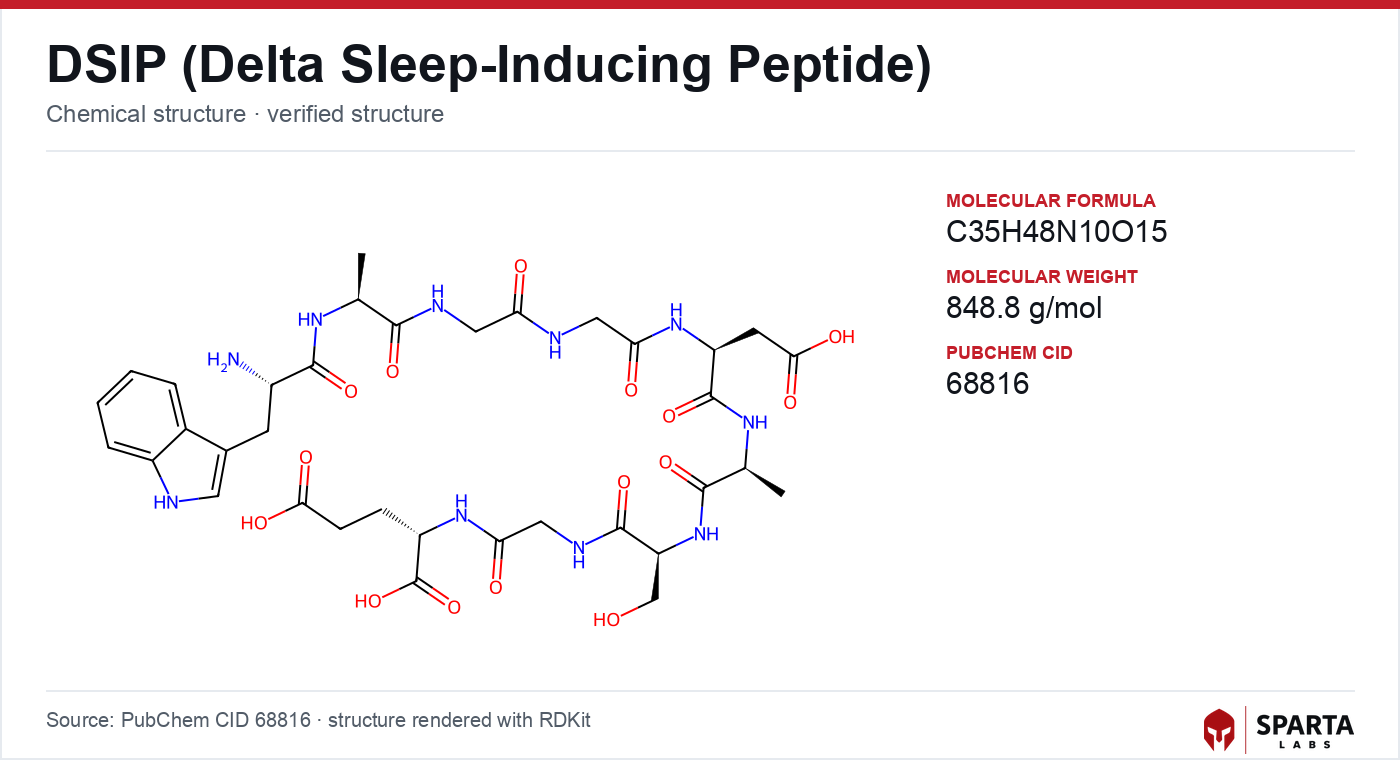
Figure: chemical structure of DSIP.
The Receptor Question
A defining feature of the DSIP literature is the absence of a conclusively characterized receptor. A 2006 review published in the Journal of Neurochemistry by Kovalzon and Strekalova surveyed roughly three decades of work and characterized DSIP as a "still unresolved riddle," noting that no specific membrane receptor for the peptide had been cloned or definitively identified despite extensive investigation [2].
The authors reported that many of the physiological effects attributed to DSIP had proven difficult to replicate consistently across laboratories, and they emphasized that the peptide's mode of action was better described as an open question than as a settled pathway [2].
Findings from research models do not establish safety or efficacy in humans. Sparta Labs makes no claims about the use of this compound.
An earlier comprehensive review by Graf and Kastin, published in Peptides in 1986, similarly reported that DSIP appeared to interact with several neurotransmitter and neuromodulator systems rather than acting through a single dedicated receptor [3]. The review catalogued reported associations with adrenergic, serotonergic, and opioidergic signaling, while stating that a unifying molecular mechanism remained to be established [3]. This distributed, multi-system profile is a recurring theme across the mechanistic literature and complicates efforts to assign the peptide a single molecular target.
Proposed Neurotransmitter-System Modulation
In the absence of a defined receptor, much of the mechanistic work on DSIP has examined its reported interactions with established neurotransmitter systems in preclinical models.
Serotonergic signaling and thermoregulation
A 1994 study in Peptides by Tsunashima and colleagues examined the effect of DSIP on core body-temperature changes induced by serotonergic agonists in rats [4]. The authors reported that DSIP altered the thermoregulatory response to these agonists and interpreted the observed effect as primarily mediated through a 5-HT1A serotonergic mechanism in that model [4]. This work is frequently cited as evidence that at least some DSIP-associated effects can be linked to a specific, identifiable receptor subtype within an existing neurotransmitter system, rather than to a novel DSIP-specific pathway.
Adrenergic and opioidergic interactions
The Graf and Kastin review summarized reports that DSIP administration was associated with changes in catecholamine handling and with modulation of opioid-peptide interactions in various experimental preparations [3]. Subsequent literature has continued to explore whether DSIP influences the interaction of endogenous enkephalins with opioid receptors, a hypothesis that has been raised in connection with reported analgesic and anticonvulsant observations in animal studies. These proposed interactions were described by the reviewing authors as candidate contributors to the peptide's broad physiological profile rather than as fully characterized pathways [3].
Sleep-Onset and Central Effects
DSIP was originally named for its reported association with delta-wave electroencephalographic activity, and the sleep-onset literature forms part of its mechanistic record. A 1988 review in the International Journal of Neuroscience by Yehuda and Carasso discussed DSIP as a tool for investigating sleep-onset mechanisms, summarizing findings that the peptide had been associated with modifications in sleep behavior under certain experimental conditions [5].
The review framed DSIP as a probe for studying the neurochemistry of sleep onset while acknowledging that the results across studies were heterogeneous and that the peptide's precise role in physiological sleep regulation was uncertain [5].
Controlled human investigation has also been reported and is described here as attributed methodology rather than as guidance. A 1992 double-blind study in Neuropsychobiology by Bes and colleagues evaluated DSIP in a group of chronic insomniac patients and reported polysomnographic measurements comparing DSIP administration with placebo [6]. The authors reported that the measured effects on sleep parameters in that patient sample were limited, a result consistent with the broader difficulty of demonstrating robust and reproducible sleep effects noted elsewhere in the literature [2][6].
Metabolic Behavior and Its Mechanistic Implications
The pharmacology of DSIP is complicated by its metabolic behavior in biological fluids. A 1987 study in Peptides by Graf, Saegesser, and Schoenenberger examined the degradation and aggregation of DSIP and two analogs in plasma and serum [7]. The authors reported that the native peptide underwent enzymatic degradation and exhibited aggregation behavior under the conditions studied, factors that they proposed could influence the concentration of intact peptide available in circulation [7].
This rapid metabolic turnover has been raised in the literature as one possible explanation for the inconsistent reproducibility of DSIP effects across studies, since the amount and form of the peptide reaching central sites may vary substantially between experimental preparations.
Recent Preclinical Mechanistic Work
More recent research has continued to probe DSIP in defined animal models. A 2021 study in Molecules by Tukhovskaya and colleagues examined DSIP in a focal-stroke model in Sprague-Dawley rats and reported measurements related to motor-function recovery in the treated animals compared with controls [8].
The authors discussed possible neuroprotective and neuromodulatory mechanisms as candidate explanations for the observed differences, while framing the work as preclinical and hypothesis-generating [8]. Studies of this kind extend the mechanistic inquiry beyond the classical sleep and thermoregulation contexts, but they do not resolve the underlying question of a primary molecular target.
Limits of Current Understanding
The mechanistic picture of DSIP is defined as much by open questions as by established findings. No specific DSIP receptor has been definitively characterized in the accessible literature, and the peptide's reported effects appear distributed across multiple neurotransmitter systems rather than concentrated at a single site [2][3]. The compound's susceptibility to enzymatic degradation and aggregation in plasma introduces additional variability that complicates the interpretation of both in vivo and in vitro results [7]. Reproducibility across laboratories has been described as inconsistent, a point emphasized in the 2006 review [2].
Comparable questions of target identification and pathway mapping characterize other endogenous neuropeptides under study; the analytical framework used for compounds such as oxytocin acetate illustrates how receptor-level characterization advances a mechanistic account, and highlights by contrast what remains outstanding for DSIP. Verified reference-grade material, such as the DSIP peptide offered for laboratory research, is a prerequisite for the kind of controlled comparative work that could help address these gaps.
References
-
Schoenenberger GA, Maier PF, Tobler HJ, Wilson K, Monnier M. The delta EEG (sleep)-inducing peptide (DSIP). XI. Amino-acid analysis, sequence, synthesis and activity of the nonapeptide. Pflügers Archiv: European Journal of Physiology. 1978;376(2):119–129. PMID: 568769. https://pubmed.ncbi.nlm.nih.gov/568769/
-
Kovalzon VM, Strekalova TV. Delta sleep-inducing peptide (DSIP): a still unresolved riddle. Journal of Neurochemistry. 2006;97(2):303–309. https://doi.org/10.1111/j.1471-4159.2006.03693.x PMID: 16539679. https://pubmed.ncbi.nlm.nih.gov/16539679/
-
Graf MV, Kastin AJ. Delta-sleep-inducing peptide (DSIP): an update. Peptides. 1986;7(6):1165–1187. PMID: 3550726. https://pubmed.ncbi.nlm.nih.gov/3550726/
-
Tsunashima K, Kato N, Masui A, Takahashi K. The effect of delta sleep-inducing peptide (DSIP) on the changes of body (core) temperature induced by serotonergic agonists in rats. Peptides. 1994;15(1):61–65. PMID: 8015981. https://pubmed.ncbi.nlm.nih.gov/8015981/
-
Yehuda S, Carasso RL. DSIP, a tool for investigating the sleep onset mechanism: a review. International Journal of Neuroscience. 1988;38(3–4):345–353. PMID: 3286557. https://pubmed.ncbi.nlm.nih.gov/3286557/
-
Bes F, Hofman W, Schuur J, Van Boxtel C. Effects of delta sleep-inducing peptide on sleep of chronic insomniac patients. A double-blind study. Neuropsychobiology. 1992;26(4):193–197. PMID: 1299794. https://pubmed.ncbi.nlm.nih.gov/1299794/
-
Graf MV, Saegesser B, Schoenenberger GA. Degradation and aggregation of delta sleep-inducing peptide (DSIP) and two analogs in plasma and serum. Peptides. 1987;8(4):599–603. PMID: 3628078. https://pubmed.ncbi.nlm.nih.gov/3628078/
-
Tukhovskaya EA, Ismailova AM, Shaykhutdinova ER, Slashcheva GA, Prudchenko IA, Mikhaleva II. Delta sleep-inducing peptide recovers motor function in SD rats after focal stroke. Molecules. 2021;26(17):5173. https://doi.org/10.3390/molecules26175173 PMID: 34500605. https://pubmed.ncbi.nlm.nih.gov/34500605/
Disclaimer. Statements in this article have not been evaluated by the Food and Drug Administration. This compound is not intended to diagnose, treat, cure, or prevent any disease. Sparta Labs sells research-use-only materials. Content is provided for educational and informational purposes only and does not constitute medical advice. Consult a qualified medical professional for any health concerns.
Frequently asked questions
How does DSIP work?
The DSIP mechanism of action has not been fully resolved in the published literature. Reviews have proposed that its reported effects in preclinical models may involve modulation of multiple neurotransmitter systems, including adrenergic, serotonergic, GABAergic and opioidergic signaling, rather than action at a single defined receptor. A specific high-affinity DSIP receptor has not been definitively characterized.
What receptor does DSIP target?
As of the accessible published record, no specific DSIP receptor has been definitively cloned or characterized. A 2006 review in the Journal of Neurochemistry described the compound as a still unresolved riddle, noting that a discrete membrane receptor had not been established. Some studies have instead proposed indirect modulation of existing neurotransmitter and receptor systems.
What is the mechanism of action of DSIP in thermoregulation research?
A 1994 study in Peptides reported that DSIP altered core body-temperature changes induced by serotonergic agonists in rats, and the authors interpreted the effect as primarily mediated through a 5-HT1A serotonergic mechanism. This is one of several neurotransmitter-linked mechanisms proposed in preclinical work, and it was described in the context of a specific animal model.
Is the DSIP mechanism of action well understood?
No. Decades of published research have characterized numerous reported effects of DSIP across sleep, thermoregulation, and stress-response models, but the underlying molecular mechanism remains incompletely defined. Reviews have consistently described the peptide's mode of action as an open scientific question rather than a settled one.