
Retatrutide: A Research Overview
Retatrutide (LY3437943) is a synthetic acylated peptide engineered as a single-molecule agonist at three metabolic receptors. This reference profiles its GIP-derived scaffold, unbalanced triple-receptor potency, and place in the incretin-peptide development timeline.

For research use only. Not for human consumption. This article is educational reference material. It is not medical advice and is not a recommendation to use any substance.
What retatrutide is
Retatrutide (development code LY3437943) is a synthetic acylated peptide reported by Eli Lilly and Company. In the peer-reviewed literature it is classified as a single molecule that acts as an agonist at three distinct class B G protein-coupled receptors simultaneously: the glucose-dependent insulinotropic polypeptide receptor (GIPR), the glucagon-like peptide-1 receptor (GLP-1R), and the glucagon receptor (GCGR) [1]. Because it engages three receptor systems at once, the literature refers to it as a "triple agonist," "triagonist," or "triple incretin receptor agonist." This article is an educational reference to retatrutide's chemical identity, the engineering logic behind its receptor pharmacology, and its position in the timeline of incretin-peptide research. It reports what the primary literature describes and makes no claims of its own.
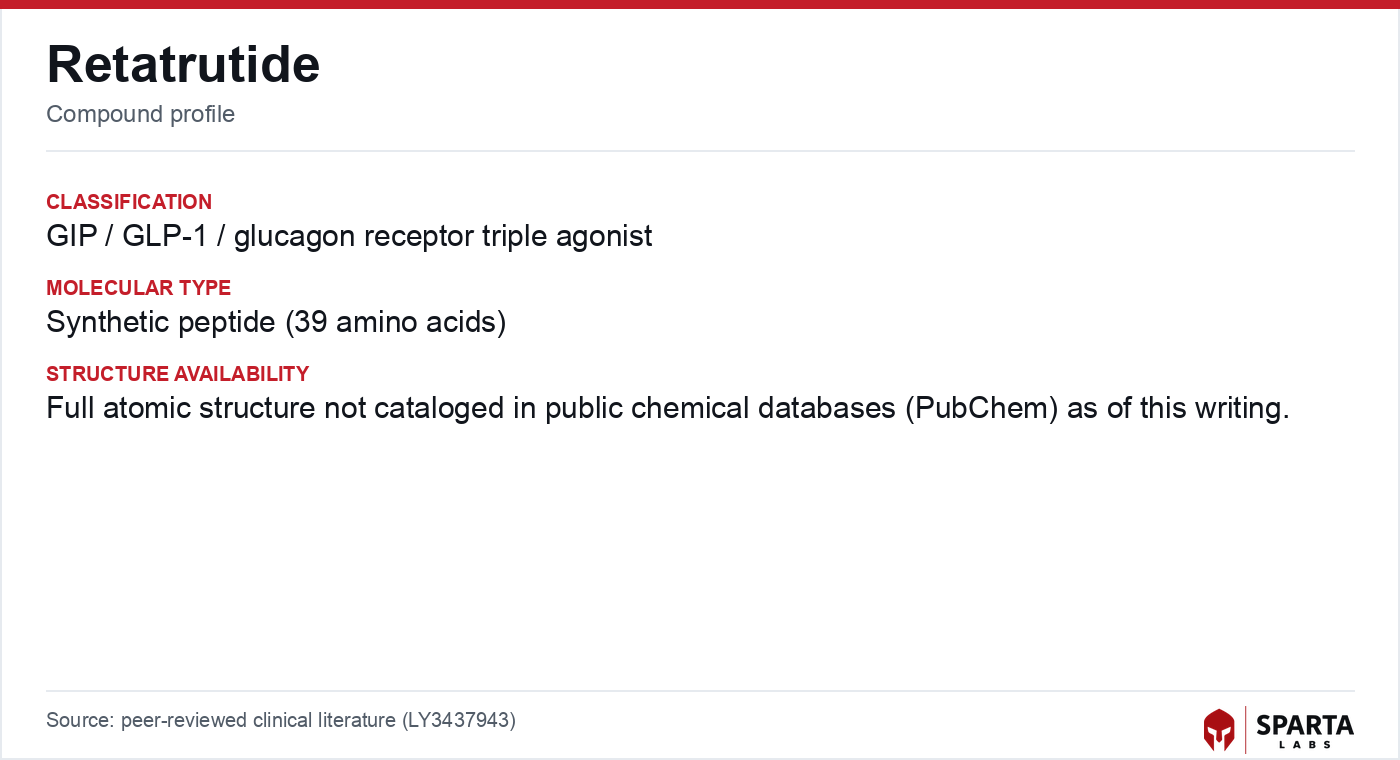
Figure: chemical structure of retatrutide.
The three-receptor design problem
The distinctive feature of retatrutide is that a single peptide must bind and activate three receptors whose natural ligands are related but distinct hormones. GIP, GLP-1, and glucagon all derive from the same ancestral peptide-hormone family and share sequence homology, but each receptor discriminates its own ligand. Engineering one sequence that all three receptors accept required balancing agonist activity across targets rather than optimizing for any one of them.
The intellectual groundwork for this approach predates retatrutide. Finan and colleagues reported in 2015 the first "unimolecular" peptide combining GIP, GLP-1, and glucagon receptor agonism in a single chain, establishing proof of concept that one engineered ligand could co-activate all three receptors in rodent metabolic models [2]. Retatrutide represents a later, clinically advanced entry in that lineage.
Findings from research models do not establish safety or efficacy in humans. Sparta Labs makes no claims about the use of this compound.
This triple-target strategy also sits one step beyond dual incretin agonism. The dual GIP/GLP-1 agonist tirzepatide, characterized in earlier work by Frías and colleagues, demonstrated that co-engagement of two incretin receptors was clinically tractable [3]. Retatrutide's design question was whether adding a third receptor, glucagon, to that dual base was feasible in one molecule. Readers comparing the two scaffolds may find the tirzepatide research overview a useful companion reference.
An unbalanced triple potency
A common misreading of "triple agonist" is that retatrutide activates all three receptors equally. The published in vitro pharmacology reports the opposite: the potencies are deliberately unbalanced relative to the native hormones. In the characterization by Coskun and colleagues, retatrutide was reported to display substantially greater potency at the GIP receptor than native GIP, while acting at the glucagon and GLP-1 receptors at potencies lower than their respective native ligands, glucagon and GLP-1 [1].
This asymmetry is a design decision rather than an artifact. Glucagon receptor agonism carries different downstream physiology from incretin-receptor agonism, and the literature describes the relative "tuning" of the three activities as central to the compound's reported preclinical profile. The receptor-level detail, including binding and signaling data, is treated at length in the retatrutide mechanism of action article. The practical consequence for classification is that "triagonist" describes the number of receptors engaged, not an equal split of activity among them.
Chemistry: a GIP-derived acylated scaffold
Retatrutide is a synthetic peptide built on a backbone derived from the native human GIP sequence, rather than from GLP-1 or glucagon [1]. This scaffold choice distinguishes it chemically from GLP-1-based agents such as semaglutide, whose sequence descends from the GLP-1 peptide. Onto the GIP-derived core, the molecule carries amino acid substitutions that redistribute agonist activity across the three receptors and stabilize the peptide against enzymatic degradation.
The molecule is acylated: a fatty-acid (fatty diacid) moiety is attached through a linker. In the broader class of acylated incretin peptides, this lipid appendage promotes non-covalent binding to circulating serum albumin, which in the reported pharmacokinetics is associated with an extended circulating half-life and slower clearance [1]. This is the same general chemical strategy used across several long-acting peptide agents, and it is one reason retatrutide is grouped with the acylated incretin peptides rather than with unmodified native hormones. Analytical and purity considerations for peptides of this class are discussed in the retatrutide sourcing and quality reference.
Structural context at the receptor
Beyond the amino acid sequence, structural biology has examined how a single peptide can dock into three related receptor architectures. Class B GPCRs such as GIPR, GLP-1R, and GCGR share a two-domain activation model: an extracellular domain that captures the peptide's C-terminal region, and a transmembrane domain into which the peptide's N-terminus inserts to trigger signaling. A triagonist must present compatible contacts for all three receptor pockets. The reported preclinical data describe retatrutide as achieving productive engagement of each of the three receptor complexes, which is the structural basis for its classification [1]. The downstream signaling consequences of that engagement are outside the scope of an overview and are addressed in the dedicated mechanism reference.
Placement in the incretin-peptide timeline
Retatrutide is best understood as one node in a progression of receptor-target additions within engineered peptide agonists. Selective GLP-1 receptor agonists came first. Dual GIP/GLP-1 agonism followed with tirzepatide. Triple GIP/GLP-1/glucagon agonism, of which retatrutide is a clinically studied example, adds the glucagon receptor to that base [1,2,3].
Parallel development lines have combined incretin agonism with other hormone systems entirely. The dual GLP-1/glucagon agonist mazdutide and the amylin analog cagrilintide illustrate how the field has explored several distinct receptor combinations rather than a single path. Retatrutide's specific contribution to this map is the three-receptor GIP/GLP-1/glucagon combination on a GIP-derived scaffold.
Development status
In the peer-reviewed record, retatrutide progressed from first-in-human characterization through phase 2 clinical evaluation. Coskun and colleagues reported the discovery, preclinical profile, and phase 1 proof-of-concept in 2022 [1]. Phase 2 results were subsequently published in two populations: an obesity/overweight cohort reported by Jastreboff and colleagues in the New England Journal of Medicine in 2023 [4], and a type 2 diabetes cohort reported by Rosenstock and colleagues in The Lancet in 2023 [5]. Later-phase clinical development has been reported under the TRIUMPH and TRANSCEND program names.
As described in these publications, retatrutide is an investigational compound that had not received marketing approval from the FDA, the European Medicines Agency, or any comparable regulatory authority for any indication at the time of writing. Research-use-only handling is governed by institutional and regulatory frameworks distinct from those applying to approved pharmaceuticals. The discovery and regulatory chronology is expanded in the retatrutide discovery and regulatory history article. Research-grade retatrutide from Sparta Labs is supplied with third-party-verified purity documentation.
The compound's discovery and trial-program timeline is traced in retatrutide: history.
References
-
Coskun T, Urva S, Roell WC, Qu H, Loghin C, Moyers JS, et al. LY3437943, a novel triple glucagon, GIP, and GLP-1 receptor agonist for glycemic control and weight loss: from discovery to clinical proof of concept. Cell Metab. 2022;34(9):1234-1247.e9. DOI: 10.1016/j.cmet.2022.07.013
-
Finan B, Yang B, Ottaway N, Smiley DL, Ma T, Clemmensen C, et al. A rationally designed monomeric peptide triagonist corrects obesity and diabetes in rodents. Nat Med. 2015;21(1):27-36. DOI: 10.1038/nm.3761
-
Frías JP, Nauck MA, Van J, Kutner ME, Cui X, Benson C, et al. Efficacy and tolerability of the novel dual glucose-dependent insulinotropic polypeptide and glucagon-like peptide-1 receptor agonist LY3298176 in patients with type 2 diabetes: a randomised, placebo-controlled and active comparator-controlled phase 2 trial. Lancet. 2018;392(10160):2180-2193. DOI: 10.1016/S0140-6736(18)32260-8
-
Jastreboff AM, Kaplan LM, Frías JP, Wu Q, Du Y, Gurbuz S, et al. Triple-hormone-receptor agonist retatrutide for obesity: a phase 2 trial. N Engl J Med. 2023;389(6):514-526. DOI: 10.1056/NEJMoa2301972
-
Rosenstock J, Frías JP, Jastreboff AM, Du Y, Lou J, Gurbuz S, et al. Retatrutide, a GIP, GLP-1 and glucagon receptor agonist, for people with type 2 diabetes: a randomised, double-blind, placebo and active-controlled, parallel-group, phase 2 trial conducted in the USA. Lancet. 2023;402(10401):529-544. DOI: 10.1016/S0140-6736(23)01053-X
Disclaimer. Statements in this article have not been evaluated by the Food and Drug Administration. This compound is not intended to diagnose, treat, cure, or prevent any disease. Sparta Labs sells research-use-only materials. Content is provided for educational and informational purposes only and does not constitute medical advice. Consult a qualified medical professional for any health concerns.
Frequently asked questions
What is retatrutide?
Retatrutide is an investigational synthetic peptide described in published research as a triple agonist acting at the GLP-1, GIP, and glucagon receptors. It carries the development code LY3437677 and is categorized within the incretin-mimetic peptide class. It has not been approved by the FDA for any use.
Is retatrutide a peptide?
Yes. Retatrutide is a synthetic peptide, a molecule built from a chain of amino acids. Published literature describes it as an engineered peptide agonist designed to interact with three receptors, and it is often grouped with other incretin-mimetic peptides in the scientific record.
Is retatrutide a GLP-1?
Research literature describes retatrutide as more than a single-target GLP-1 agonist. It is characterized as a triple agonist that engages the GLP-1 receptor alongside the GIP and glucagon receptors, distinguishing it from single-receptor GLP-1 agonists within the incretin-mimetic class.
How does retatrutide work?
According to published pharmacology research, retatrutide is reported to act as an agonist at three receptors simultaneously: GLP-1, GIP, and glucagon. Studies describe this triple-receptor mechanism as the basis for its investigation, though findings from research models do not establish safety or efficacy in humans.
Is retatrutide FDA approved?
No. Retatrutide is not approved by the U.S. Food and Drug Administration for any use. Published reports describe it as an investigational compound that has been studied in clinical trials, and it remains an experimental molecule under evaluation in the scientific literature.
When will retatrutide be FDA approved?
There is no FDA approval date for retatrutide, and no approval has been announced. Published sources describe it as an investigational compound still progressing through the clinical-trial process; regulatory timelines depend on trial outcomes and formal FDA review, neither of which has been completed.