
Tirzepatide: A Research Overview
How tirzepatide was engineered as a single-molecule GIP and GLP-1 receptor agonist: its GIP-derived sequence, albumin-binding fatty-acid tail, imbalanced receptor pharmacology, and layered FDA approval history.

For research use only. Not for human consumption. This article is educational reference material. It is not medical advice and is not a recommendation to use any substance.
Introduction
Tirzepatide (development code LY3298176) is a synthetic 39-amino-acid peptide engineered to engage two incretin receptors with a single molecule: the glucose-dependent insulinotropic polypeptide (GIP) receptor and the glucagon-like peptide-1 (GLP-1) receptor. Developed by Eli Lilly and Company, it was the first molecule of its pharmacological class to reach regulatory approval, which has kept it a recurring subject of cardiometabolic and receptor-pharmacology research. This overview reads the peptide from the outside in: how a native hormone sequence was repurposed as a scaffold, why a fatty-acid tail was grafted onto it, how the resulting molecule partitions its activity between two receptors, and how those properties map onto a documented regulatory record.
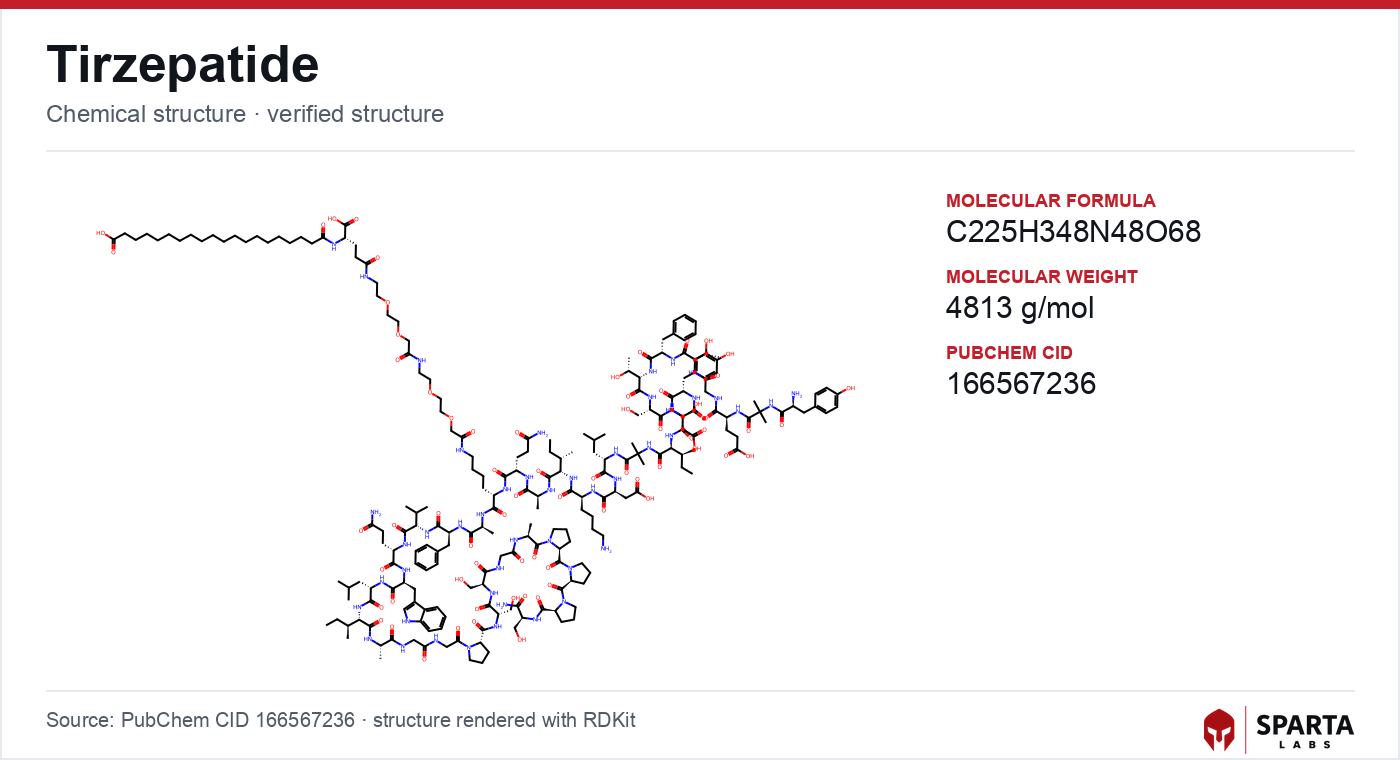
Figure: chemical structure of Tirzepatide.
A Single Molecule, Two Receptors
The defining feature of tirzepatide is that one peptide backbone carries affinity for two distinct incretin receptors that had, until its development, been addressed by separate drug classes. The incretin system comprises intestinally derived peptide hormones that modulate insulin secretion in a glucose-dependent manner, and the two principal members, GIP and GLP-1, were characterized through independent lines of research beginning in the 1970s and 1980s. Earlier therapeutic development had produced selective GLP-1 receptor agonists; tirzepatide was designed instead as a "twincretin," a single agent addressing both receptor subtypes at once.
The foundational preclinical and early clinical characterization of tirzepatide was reported by Coskun and colleagues in 2018, describing the molecule under its experimental designation LY3298176 [1]. That paper documented the compound's design rationale, receptor-binding profile, and early human pharmacokinetic data, establishing tirzepatide's scientific identity in the peer-reviewed record.
Findings from research models do not establish safety or efficacy in humans. Sparta Labs makes no claims about the use of this compound.
The dual-receptor design distinguishes tirzepatide from selective GLP-1 receptor agonists such as semaglutide and situates it within a broader wave of multi-receptor incretin analogues that also includes triple GIP/GLP-1/glucagon agonists such as retatrutide and glucagon/GLP-1 co-agonists such as mazdutide.
Reading the Sequence: A GIP-Derived Scaffold
Tirzepatide's 39-residue primary sequence was derived from the native human GIP sequence rather than from GLP-1. That choice of scaffold is significant: the GIP backbone provides the structural framework for high-affinity GIP receptor engagement, while targeted substitutions were introduced so the same chain retains meaningful activity at the GLP-1 receptor. In effect, the molecule reads as a modified GIP peptide that has been coaxed into cross-reactivity, rather than a GLP-1 analogue extended to reach GIP.
The reported design also incorporated non-native amino acids at positions vulnerable to enzymatic degradation. Native GIP and GLP-1 have biological half-lives measured in minutes because dipeptidyl peptidase-4 (DPP-4) rapidly cleaves them near their N-termini. Substituting the residues at those cleavage-sensitive positions confers resistance to DPP-4, one of two structural strategies the molecule uses to persist in circulation [1].
The Fatty-Acid Tail and Circulating Half-Life
The second persistence strategy is a lipidation approach borrowed from the broader long-acting-peptide field. A C20 fatty diacid moiety is attached, via a linker, to a lysine residue on the peptide chain. This appendage does not participate directly in receptor binding; instead it mediates reversible, non-covalent binding to circulating serum albumin [1].
Because albumin is abundant and long-lived in plasma, a peptide that docks onto it is shielded from renal clearance and enzymatic turnover, and is released gradually back into the free, receptor-active pool. The combined effect of DPP-4-resistant substitutions and albumin-anchoring lipidation is a molecule with a circulating residence time far longer than the native incretins from which it was derived. The same albumin-binding fatty-acid principle appears in other long-acting incretin analogues, including semaglutide and the amylin analogue cagrilintide, underscoring how a single formulation strategy has shaped an entire class.
The reported molecular weight of tirzepatide is approximately 4,813 daltons, consistent with a 39-residue peptide bearing a C20 diacid modification.
Imbalanced and Biased Receptor Pharmacology
Tirzepatide does not engage its two receptors symmetrically, and that asymmetry is one of its most-studied properties. Willard and colleagues (2020) characterized the molecular pharmacology of the compound in detail, reporting that it behaves as a full agonist at the GIP receptor while acting as a biased agonist at the GLP-1 receptor, favoring cyclic AMP (cAMP) generation over beta-arrestin recruitment [2]. Because beta-arrestin recruitment is associated with receptor internalization and desensitization, this signaling bias is a frequently cited feature in the pharmacology literature.
The structural basis for the dual agonism was further elaborated in a 2022 cryo-electron microscopy study published in the Proceedings of the National Academy of Sciences, which resolved how the single peptide is accommodated at both receptor complexes and identified the determinants of engagement at each [3]. Together, these studies established tirzepatide as a pharmacologically novel probe for dissecting the respective contributions of the two incretin pathways. A more detailed treatment of receptor engagement and downstream signaling appears in the tirzepatide mechanism of action article, and the corresponding trial literature is summarized in the tirzepatide published research overview.
A Layered Regulatory Record
Tirzepatide's regulatory history is notable for arriving in distinct stages under separate brand names and indications. It received its first United States Food and Drug Administration (FDA) approval on May 13, 2022, under the brand name Mounjaro, as an adjunct to diet and exercise to improve glycemic control in adults with type 2 diabetes mellitus (NDA 215866) [4]. This made tirzepatide the first FDA-approved dual GIP and GLP-1 receptor agonist.
On November 8, 2023, the FDA granted a second approval under the brand name Zepbound for chronic weight management in adults with obesity, or with overweight and at least one weight-related comorbidity [5]. A further indication for obstructive sleep apnea was approved in December 2024, marking a third distinct regulatory context recognized by the agency. The tiered timeline is treated in more depth in the tirzepatide discovery and regulatory history article.
Tirzepatide's status as an approved prescription pharmaceutical and its handling as a research-use-only material in non-clinical settings are governed by separate frameworks. Analytical documentation for research material, including batch-specific data, is listed on the tirzepatide product page.
References
-
Coskun T, Sloop KW, Loghin C, Alsina-Fernandez J, Urva S, Bokvist KB, et al. LY3298176, a novel dual GIP and GLP-1 receptor agonist for the treatment of type 2 diabetes mellitus: from discovery to clinical proof of concept. Mol Metab. 2018;18:3-14. DOI: 10.1016/j.molmet.2018.09.009. Link
-
Willard FS, Douros JD, Gabe MBN, Showalter AD, Wainscott DB, Suter TM, et al. Tirzepatide is an imbalanced and biased dual GIP and GLP-1 receptor agonist. JCI Insight. 2020;5(17):e140532. PMID: 32730231. DOI: 10.1172/jci.insight.140532. Link
-
Sun B, Willard FS, Feng D, Alsina-Fernandez J, Chen Q, Vieth M, et al. Structural determinants of dual incretin receptor agonism by tirzepatide. Proc Natl Acad Sci USA. 2022;119(13):e2116506119. PMID: 35333651. DOI: 10.1073/pnas.2116506119. Link
-
US Food and Drug Administration. Mounjaro (tirzepatide) injection: NDA 215866 approval letter. May 13, 2022. Link
-
US Food and Drug Administration. FDA approves new medication for chronic weight management. Press announcement. November 8, 2023. Link
Disclaimer. Statements in this article have not been evaluated by the Food and Drug Administration. This compound is not intended to diagnose, treat, cure, or prevent any disease. Sparta Labs sells research-use-only materials. Content is provided for educational and informational purposes only and does not constitute medical advice. Consult a qualified medical professional for any health concerns.
Frequently asked questions
What is tirzepatide?
Tirzepatide is a synthetic 39-amino-acid peptide and the active pharmaceutical ingredient in the FDA-approved products Mounjaro and Zepbound, marketed by Eli Lilly. In the published pharmacology literature it is classified as a dual GIP and GLP-1 receptor agonist. It carries a C20 fatty-diacid moiety associated in that literature with an extended plasma half-life.
How does tirzepatide work?
Published pharmacology research reports that tirzepatide acts as a dual agonist, binding both the glucose-dependent insulinotropic polypeptide (GIP) receptor and the glucagon-like peptide-1 (GLP-1) receptor, two incretin-hormone pathways. Findings from research models do not establish safety or efficacy in humans. Sparta Labs makes no claims about the use of this compound.
Is tirzepatide a GLP-1?
Tirzepatide is described in the literature as a dual incretin receptor agonist, meaning it engages the GLP-1 receptor and also the GIP receptor. This distinguishes it from single-pathway agents such as semaglutide, which the same literature characterizes as a GLP-1 receptor agonist acting on one pathway.
Is tirzepatide a peptide?
Yes. Tirzepatide is a synthetic peptide, described in the pharmacology literature as a 39-amino-acid chain modified with a C20 fatty-diacid side chain. Its peptide backbone and this acylation are the structural features that published sources associate with its receptor binding and its prolonged plasma half-life.
What is the difference between semaglutide and tirzepatide?
Published pharmacology describes the two as structurally and pharmacologically distinct molecules. Semaglutide is characterized as a single GLP-1 receptor agonist, while tirzepatide is characterized as a dual agonist engaging both the GLP-1 and the GIP incretin receptors. They are separate compounds with different amino-acid sequences.
Is Mounjaro tirzepatide? Is Zepbound tirzepatide?
Yes. Tirzepatide is the active pharmaceutical ingredient in both Mounjaro and Zepbound, two FDA-approved brand-name products from Eli Lilly. The brand names identify the marketed products, while tirzepatide is the underlying compound named in their respective FDA approvals.