
Sermorelin: Discovery and Regulatory History
A chronological account of sermorelin's development: from the 1982 isolation of native GHRH through the identification of the biologically active GRF(1-29) fragment, FDA approval of Geref, and its 2008 market withdrawal. Educational reference.
For research use only. Not for human consumption. This article is educational reference material. It is not medical advice and is not a recommendation to use any substance.
Introduction
Sermorelin is the international nonproprietary name for a synthetic peptide corresponding to the first 29 amino acid residues of human growth hormone-releasing hormone (GHRH), designated GHRH(1-29)-NH2 or GRF(1-29)-NH2. Pharmacologically it is classified as a growth hormone-releasing hormone analog, a member of the broader family of growth hormone secretagogues. Its development history is inseparable from the discovery of native GHRH itself, an event that resolved a decades-long question in neuroendocrinology, and from the subsequent recognition that a truncated fragment of that hormone retained its defining biological activity. This article traces that lineage chronologically, from the isolation of native GHRH through the identification of the active fragment, the regulatory record of the brand-name product Geref, and the current research landscape.
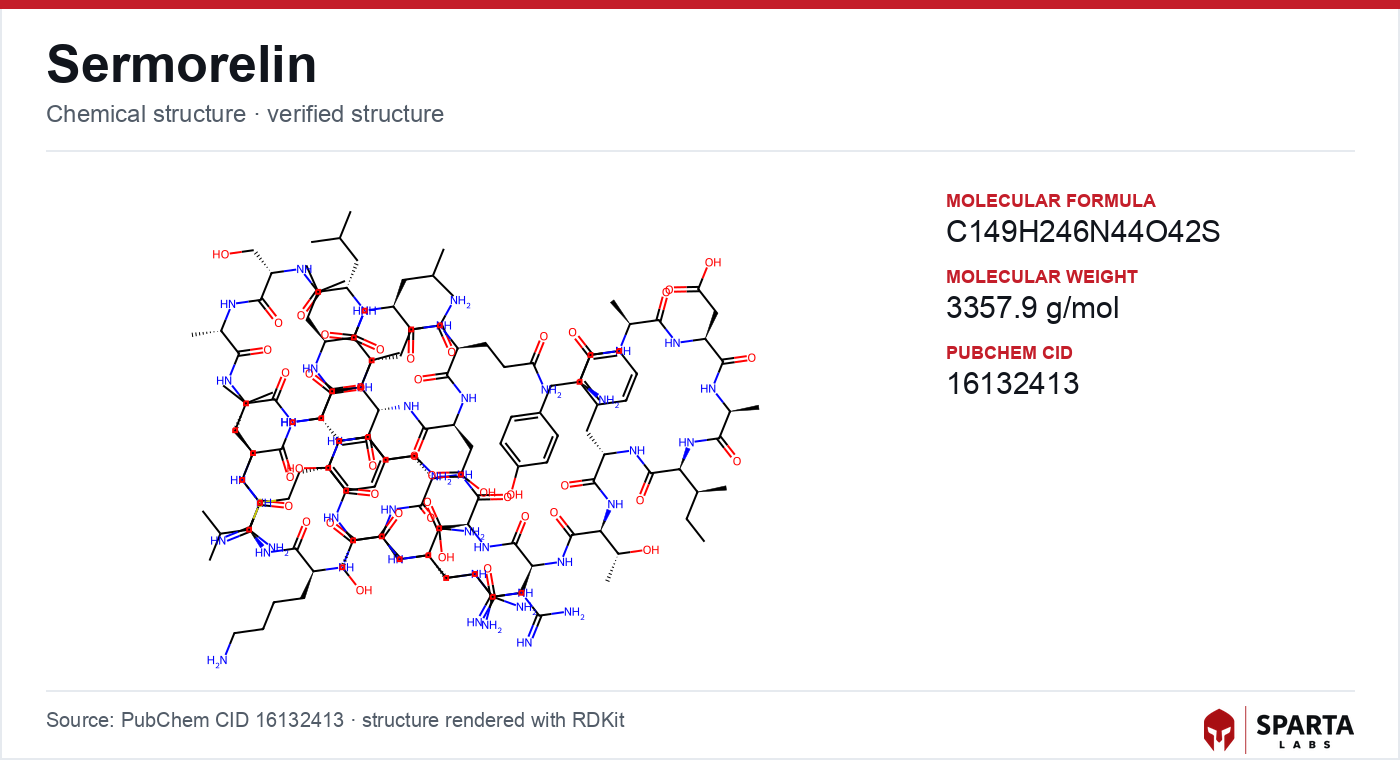
Figure: chemical structure of sermorelin.
Discovery Period: Isolation of Native GHRH (1982)
The existence of a hypothalamic factor that stimulates pituitary growth hormone secretion had been postulated since the 1950s, but the factor itself resisted isolation for decades. The peptide was produced in vanishingly small quantities in hypothalamic neurons and was rapidly degraded, making direct isolation from brain tissue impractical.
The breakthrough arrived in 1982 from an unexpected source: pancreatic tumor tissue. Guillemin, Brazeau, Böhlen, Esch, Ling, and Wehrenberg reported the isolation, characterization, and synthesis of a 44-residue amidated peptide from the pancreatic tumor of a patient with acromegaly, publishing the sequence in Science [1]. Independently and concurrently, Rivier, Spiess, Thorner, and Vale characterized a homologous growth hormone-releasing factor from a second patient's pancreatic islet tumor and published the structure in Nature [2].
Findings from research models do not establish safety or efficacy in humans. Sparta Labs makes no claims about the use of this compound.
Human hypothalamic GHRH was subsequently confirmed to share the primary sequence of these tumor-derived peptides, validating ectopic tumor tissue as an accessible source for characterizing what had previously been an intractable target. These reports completed the identification of the two principal hypothalamic regulators of the growth hormone axis: GHRH as the stimulatory factor and somatostatin, isolated by Guillemin's group a decade earlier, as the inhibitory counterpart.
Early Research: Identification of the Active Fragment
Once the full 44-residue sequence was known, structure-activity investigation turned to which portion of the molecule carried its biological activity. Research through the early 1980s established that the activity resided in the amino-terminal region and that the first 29 residues were sufficient. Grossman and colleagues, working with a series of synthetic GHRH analogs, reported in 1984 that GRF(1-29)-NH2 was equipotent with the longer GRF(1-40) form in stimulating growth hormone release [3]. Prakash and Goa, in a later review of the compound, summarized this body of work by describing GHRH(1-29)-NH2 as the shortest synthetic peptide retaining the full intrinsic activity of native GHRH [4].
This finding was significant for pharmaceutical chemistry: a 29-residue peptide is materially easier to synthesize at scale and characterize than the 44-residue parent, while retaining the receptor-binding determinants that define GHRH activity. The GRF(1-29)-NH2 fragment became the molecular basis for the compound later assigned the nonproprietary name sermorelin. The molecular details of how this fragment engages the GHRH receptor are examined in the sermorelin mechanism of action article.
Regulatory Milestones
Sermorelin acetate advanced into pharmaceutical development and was marketed under the brand name Geref. The US regulatory record is documented in FDA New Drug Application filings and in Federal Register notices.
According to the published regulatory record, sermorelin acetate was the subject of two New Drug Applications. NDA 19-863 was approved first, and a second application, NDA 20-443, was later approved in 1997 [5]. Both applications were held by EMD Serono.
In a letter dated December 2, 2008, the application holder notified FDA that Geref was being discontinued and requested withdrawal of the associated New Drug Application. FDA subsequently announced withdrawal of approval of the applications, effective in 2009, as recorded in the Federal Register [5]. A later Federal Register determination, published in 2013, stated that Geref had not been withdrawn from sale for reasons of safety or effectiveness [5]. That distinction is relevant to the regulatory record because it reflects a commercial and manufacturing rationale for discontinuation rather than an adverse regulatory finding.
The compound thus occupies an unusual position in the regulatory history of GHRH analogs: it was a formally approved product that subsequently exited the US market. This trajectory contrasts with that of the later analog tesamorelin, whose parallel regulatory path is described in the tesamorelin discovery and regulatory history article, and the two molecules are contrasted directly in the tesamorelin and sermorelin comparison.
Current Research Landscape
Following the market withdrawal of Geref, sermorelin has remained a compound of interest in the published literature and in laboratory research on the growth hormone axis. As a well-characterized GHRH(1-29)-NH2 analog with an extensive prior pharmacological record, it continues to appear in research contexts examining GHRH-receptor pharmacology and the comparative properties of growth hormone secretagogues.
Contemporary references to sermorelin in the scientific literature draw on the foundational 1980s characterization work rather than on new regulatory activity, since the compound is not currently marketed as an approved product in the United States. Research-grade material used in laboratory settings is manufactured and verified independently of the historical pharmaceutical supply chain; the analytical standards applied to such material are described in the sermorelin sourcing and quality article. Laboratories seeking research-grade sermorelin from Sparta Labs can obtain third-party Certificate of Analysis documentation with each lot.
References
-
Guillemin R, Brazeau P, Böhlen P, Esch F, Ling N, Wehrenberg WB. Growth hormone-releasing factor from a human pancreatic tumor that caused acromegaly. Science. 1982;218(4572):585-7. PMID: 6812220. DOI: 10.1126/science.6812220
-
Rivier J, Spiess J, Thorner M, Vale W. Characterization of a growth hormone-releasing factor from a human pancreatic islet tumour. Nature. 1982;300(5889):276-8. PMID: 6292724. DOI: 10.1038/300276a0
-
Grossman A, Savage MO, Lytras N, Preece MA, Sueiras-Diaz J, Coy DH, et al. Responses to analogues of growth hormone-releasing hormone in normal subjects, and in growth-hormone deficient children and young adults. Clin Endocrinol (Oxf). 1984;21(3):321-30. DOI: 10.1111/j.1365-2265.1984.tb03477.x
-
Prakash A, Goa KL. Sermorelin: a review of its use in the diagnosis and treatment of children with idiopathic growth hormone deficiency. BioDrugs. 1999;12(2):139-57. PMID: 18031173. DOI: 10.2165/00063030-199912020-00007
-
U.S. Food and Drug Administration. Determination That GEREF (Sermorelin Acetate) Injection Products Were Not Withdrawn From Sale for Reasons of Safety or Effectiveness. Federal Register. 2013;78(42):14126. Available at: https://www.federalregister.gov/documents/2013/03/04/2013-04827/
Disclaimer. Statements in this article have not been evaluated by the Food and Drug Administration. This compound is not intended to diagnose, treat, cure, or prevent any disease. Sparta Labs sells research-use-only materials. Content is provided for educational and informational purposes only and does not constitute medical advice. Consult a qualified medical professional for any health concerns.
Frequently asked questions
When was sermorelin discovered?
Sermorelin corresponds to the first 29 amino acids of native human GHRH, which was isolated and structurally characterized in 1982 by two groups working with pancreatic tumor tissue from patients with acromegaly. Work in the early 1980s subsequently established that the 1-to-29 fragment retained the full intrinsic activity of the parent peptide, defining the molecule later assigned the international nonproprietary name sermorelin.
What is sermorelin derived from?
Sermorelin is a synthetic peptide corresponding to residues 1 through 29 of human growth hormone-releasing hormone, GHRH(1-29)-NH2. Research reported that this N-terminal fragment is the shortest sequence retaining the full biological activity of the 44-residue native hormone at the GHRH receptor.
Was sermorelin FDA approved?
Sermorelin acetate was previously the subject of two US New Drug Applications: NDA 19-863 and NDA 20-443, marketed under the brand Geref and held by EMD Serono. FDA records document that approval of both applications was withdrawn effective in 2009 following the manufacturer's request; a 2013 Federal Register determination stated the withdrawal was not for reasons of safety or effectiveness.
Why was Geref (sermorelin) discontinued?
According to FDA regulatory records, EMD Serono notified the agency in a letter dated December 2, 2008 that Geref was being discontinued and requested withdrawal of the New Drug Application. The published regulatory record attributes the discontinuation to commercial and manufacturing factors rather than to safety or effectiveness concerns.