
Tesamorelin vs Sermorelin: A Structural and Regulatory Comparison
A structural and regulatory comparison of tesamorelin and sermorelin, two synthetic growth-hormone-releasing hormone (GHRH) analogs that differ in sequence length, stabilization chemistry, and approval history. Educational reference.

For research use only. Not for human consumption. This article is educational reference material. It is not medical advice and is not a recommendation to use any substance.
The search phrase "tesamorelin vs sermorelin" pairs two synthetic analogs of human growth-hormone-releasing hormone (GHRH) that are frequently discussed together because they belong to the same pharmacological class and share the same receptor target. This article compares tesamorelin and sermorelin strictly along the dimensions permitted for a structural and regulatory comparison: sequence length and derivation, stabilization chemistry, reported half-life strategy, and each compound's regulatory history. It does not compare their relative activity, does not describe any use, and does not conclude that either compound is preferable for any purpose. Both are best understood as reference materials whose published records are tied to their respective clinical and regulatory histories. Research-grade sermorelin and tesamorelin reference materials are cataloged as laboratory chemicals for research use only.
Sermorelin profile
Origin and derivation
Sermorelin is a synthetic peptide corresponding to GHRH(1-29): the first 29 amino acids of native human growth-hormone-releasing hormone, a 44-amino-acid hypothalamic hormone. The fragment GHRH(1-29) is described in the literature as the minimal sequence that retains the receptor-activating activity of the full-length hormone. Sermorelin is commonly prepared as the acetate salt (sermorelin acetate) and is assembled by peptide synthesis rather than extracted, so the material studied under the name sermorelin is a defined synthetic molecule [1].
Structure and stabilization
Structurally, sermorelin is the native GHRH(1-29) amide sequence carried without additional stabilizing modification: it does not bear the acyl caps, amino-acid substitutions, or albumin-conjugation groups that later GHRH analogs introduced. Because the unmodified GHRH sequence is a substrate for the enzyme dipeptidyl peptidase-4 (DPP-4) and other peptidases, native GHRH and its short unmodified fragments are described in the literature as having a circulating half-life on the order of minutes [1]. Sermorelin's chemistry is therefore best characterized as the baseline, unmodified GHRH fragment against which stabilized analogs are compared.
Regulatory status and research
Sermorelin acetate was marketed under the brand name Geref by Serono. According to the U.S. Food and Drug Administration's published determination, Geref (sermorelin acetate) injection first received approval on December 28, 1990, and a second Geref formulation was approved on September 26, 1997 [2]. The FDA record describes the earlier approval as indicated for evaluating the ability of the pituitary somatotroph to secrete growth hormone, and the later approval as indicated for idiopathic growth-hormone deficiency in children with growth failure [2]. The same FDA determination records that EMD Serono notified the agency in 2008 that the Geref products were being discontinued, and that the withdrawal was not for reasons of safety or effectiveness; that is, the discontinuation was commercial rather than the result of a safety signal [2]. Research-grade sermorelin sold today is a laboratory reference material, not a pharmaceutical product.
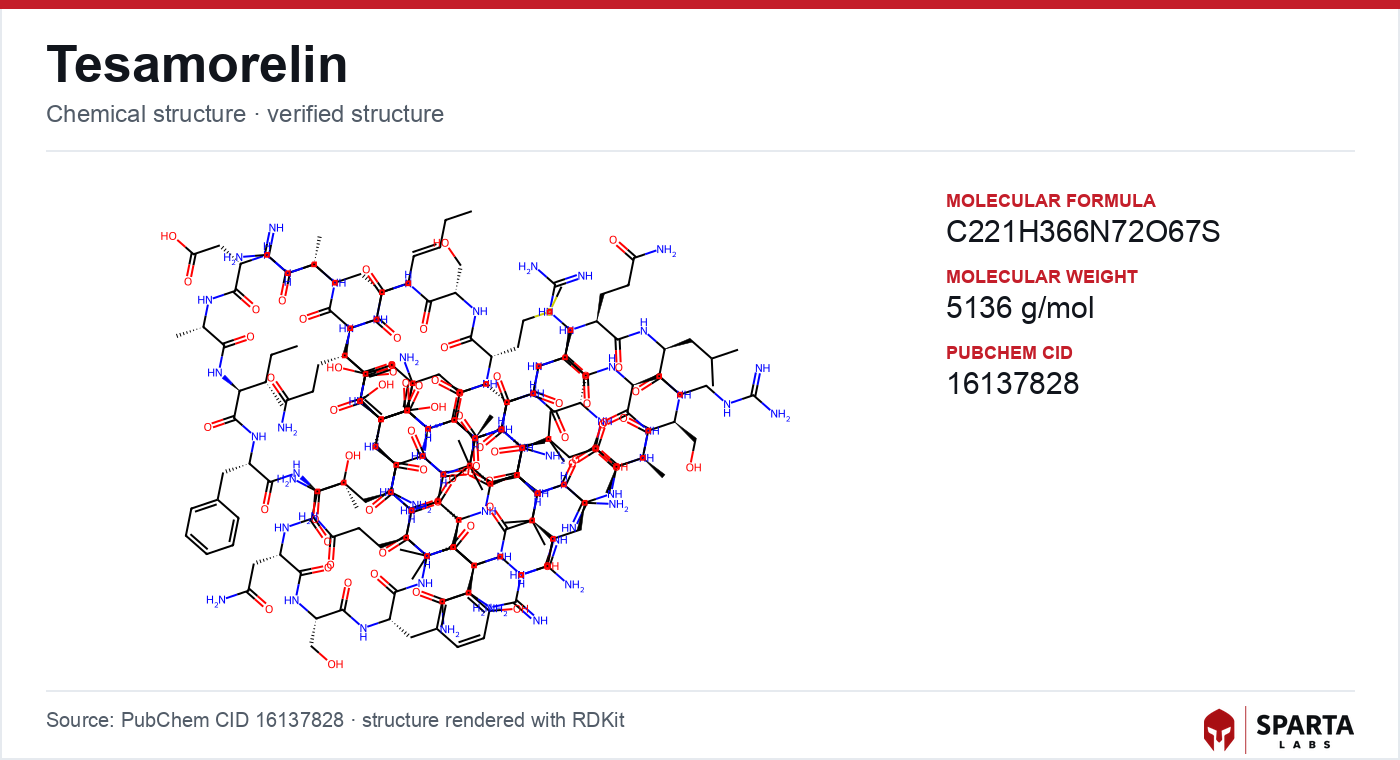
Figure: chemical structure of tesamorelin (one of the two peptides compared).
Tesamorelin profile
Origin and derivation
Tesamorelin (originally designated TH9507, marketed as Egrifta) is the complete GHRH(1-44) amide sequence: the full-length hormone rather than the truncated fragment. It differs from native GHRH by a single defined modification described below, and it was engineered as a stabilized full-length analog rather than a minimal fragment [3].
Structure and stabilization
Tesamorelin's stabilizing modification is a trans-3-hexenoyl group conjugated to the N-terminal tyrosine of the GHRH(1-44) sequence. That N-terminal acyl cap was reported to protect the molecule from DPP-4 cleavage, the enzyme chiefly responsible for the short circulating half-life of native GHRH, while leaving the receptor-interacting sequence otherwise native [3]. The compound's clinical literature includes randomized controlled trials: Falutz and colleagues reported a placebo-controlled trial of the growth-hormone-releasing factor analog in the New England Journal of Medicine in 2007 [4].
Findings from research models do not establish safety or efficacy in humans. Sparta Labs makes no claims about the use of this compound.
A later study by Stanley and colleagues reported a randomized clinical trial of its effect on visceral and liver fat in JAMA in 2014 [5]. Those findings apply to the studied clinical populations and are attributed to the studies that reported them.
Regulatory status
In 2010 the FDA approved tesamorelin under the brand name Egrifta for reduction of excess abdominal fat in HIV-infected patients with lipodystrophy [3]. Additional structural background is available in the tesamorelin research overview. Research-grade tesamorelin sold by chemical suppliers is a laboratory reference material rather than a pharmaceutical product.
Structural comparison
Placed side by side, the two compounds differ along several structural and regulatory axes while sharing the broad category of "synthetic GHRH analog."
- Sequence length. Sermorelin is the truncated GHRH(1-29) fragment, the minimal receptor-activating sequence. Tesamorelin is the full-length GHRH(1-44) amide. The two therefore differ in how much of the native hormone sequence each retains.
- Stabilization chemistry. Sermorelin carries no stabilizing modification; it is the native fragment as an acetate salt. Tesamorelin carries a trans-3-hexenoyl N-terminal acyl group reported to confer DPP-4 resistance [3]. This is the central chemical distinction between them: an unmodified fragment versus an N-terminally modified full-length analog.
- Half-life strategy. The unmodified GHRH sequence, including sermorelin, is described in the literature as short-lived on the order of minutes because it is a peptidase substrate [1]. Tesamorelin's acyl modification represents an engineering answer to that same degradation problem [3].
- Receptor. Both act at the GHRH receptor on pituitary somatotrophs; neither engages the ghrelin receptor GHS-R1a, which distinguishes this pair from the growth-hormone-releasing-peptide family (see the GHRP-2 vs GHRP-6 comparison).
- Regulatory history. Sermorelin acetate (Geref) was approved in 1990 and 1997 and discontinued for commercial reasons in 2008 [2]. Tesamorelin (Egrifta) was approved in 2010 for a specific HIV-lipodystrophy indication [3].
Pharmacological class context
Within GHRH-analog research, sermorelin and tesamorelin sit at opposite ends of a design spectrum defined by engagement of the GHRH receptor and preservation of physiologic feedback regulation. Sermorelin is generally described in the published record as the earlier, unmodified minimal fragment, GHRH(1-29), while tesamorelin is described as a later, stabilized full-length molecule. A third widely discussed class member, CJC-1295, uses a different truncation-plus-conjugation strategy and is compared in detail in the tesamorelin vs CJC-1295 article. Comparisons between class members in the published record are structural, pharmacokinetic, and regulatory; the compounds were not tested head-to-head, and this article accordingly makes no comparative efficacy statement. A broader overview of sermorelin is available in the sermorelin research overview.
References
The following references were verified against primary and official sources. No authors, years, journals, or DOIs were fabricated.
- Prakash A, Goa KL. Sermorelin: a review of its use in the diagnosis and treatment of children with idiopathic growth hormone deficiency. BioDrugs. 1999;12(2):139-157. https://pubmed.ncbi.nlm.nih.gov/18031173/ (doi:10.2165/00063030-199912020-00007; PMID: 18031173): describes sermorelin as the synthetic GHRH(1-29) fragment retaining the receptor-activating activity of native GHRH.
- U.S. Food and Drug Administration. Determination That GEREF (Sermorelin Acetate) Injection ... Were Not Withdrawn From Sale for Reasons of Safety or Effectiveness. Federal Register, 78 FR 13899, March 4, 2013. https://www.federalregister.gov/documents/2013/03/04/2013-04827/determination-that-geref-sermorelin-acetate-injection-05-milligrams-basevial-and-10-milligrams: records the 1990 and 1997 approval dates, the diagnostic and pediatric growth-hormone-deficiency indications, and the 2008 commercial discontinuation.
- U.S. Food and Drug Administration. EGRIFTA (tesamorelin for injection): approval documents and prescribing information, 2010. https://www.accessdata.fda.gov/scripts/cder/daf/index.cfm?event=overview.process&ApplNo=022505: records tesamorelin as the full-length GHRH(1-44) analog with an N-terminal trans-3-hexenoyl modification, approved in 2010 for reduction of excess abdominal fat in HIV-infected patients with lipodystrophy.
- Falutz J, Allas S, Blot K, et al. Metabolic effects of a growth hormone-releasing factor in patients with HIV. N Engl J Med. 2007;357(23):2359-2370. https://doi.org/10.1056/NEJMoa072375 (PMID: 18057338): randomized placebo-controlled trial of the tesamorelin growth-hormone-releasing factor analog.
- Stanley TL, Feldpausch MN, Oh J, et al. Effect of tesamorelin on visceral fat and liver fat in HIV-infected patients with abdominal fat accumulation: a randomized clinical trial. JAMA. 2014;312(4):380-389. https://doi.org/10.1001/jama.2014.8334 (PMID: 25038357): randomized clinical trial reporting tesamorelin's effect on visceral and liver fat.
Disclaimer. Statements in this article have not been evaluated by the Food and Drug Administration. This compound is not intended to diagnose, treat, cure, or prevent any disease. Sparta Labs sells research-use-only materials. Content is provided for educational and informational purposes only and does not constitute medical advice. Consult a qualified medical professional for any health concerns.
Frequently asked questions
What do tesamorelin and sermorelin have in common?
Both are synthetic analogs of human growth-hormone-releasing hormone (GHRH), and both act at the GHRH receptor on pituitary somatotrophs. Each is derived from the same native hypothalamic hormone, but they differ in how much of the sequence they retain and in whether the molecule carries stabilizing modifications.
What is the main structural difference between tesamorelin and sermorelin?
Sermorelin is the unmodified GHRH(1-29) fragment: the first 29 amino acids of native GHRH, prepared as an acetate salt with no stabilizing modification. Tesamorelin is the full-length GHRH(1-44) sequence carrying a trans-3-hexenoyl group at the N-terminus that was reported to resist dipeptidyl peptidase-4 cleavage.
Are tesamorelin and sermorelin FDA-approved?
Both held FDA approvals at different times. Sermorelin acetate was approved as Geref, first in 1990 and again in 1997, and the manufacturer discontinued Geref in 2008 for commercial reasons rather than for reasons of safety or effectiveness. Tesamorelin was approved as Egrifta in 2010 for a specific HIV-lipodystrophy indication. Research-grade material of either compound is sold for laboratory research use only.
Which came first, sermorelin or tesamorelin?
Sermorelin reached the US market first, with its earliest Geref approval dated 1990. Tesamorelin was approved in 2010. In the published record sermorelin is generally described as the earlier, unmodified minimal GHRH fragment, while tesamorelin is described as a later, stabilized full-length analog.