
Sermorelin: Sourcing, Purity, and Verification Standards
How Sparta Labs sources, tests, and verifies sermorelin for research applications. Educational reference.
For research use only. Not for human consumption. This article is educational reference material. It is not medical advice and is not a recommendation to use any substance.
Introduction
This article describes the sourcing, synthesis, and quality verification standards that Sparta Labs applies to research-grade sermorelin. The integrity of any pharmacological investigation depends on the chemical identity and purity of the materials under study. Sermorelin is a 29-amino-acid peptide corresponding to the N-terminal fragment of growth-hormone-releasing hormone, carrying a C-terminal amide rather than a free carboxylic acid; its molecular architecture, including that terminal amidation, is central to its chemical identity. For a peptide of this kind, quality control is not incidental to research utility: it is a prerequisite for it. Researchers will find here a description of synthesis methodology, purity standards, third-party testing practices, certificate of analysis contents, storage principles, and the reasoning behind the Sparta Labs quality posture. The sermorelin research overview provides background on the compound's pharmacological classification and regulatory status for context alongside this sourcing discussion.
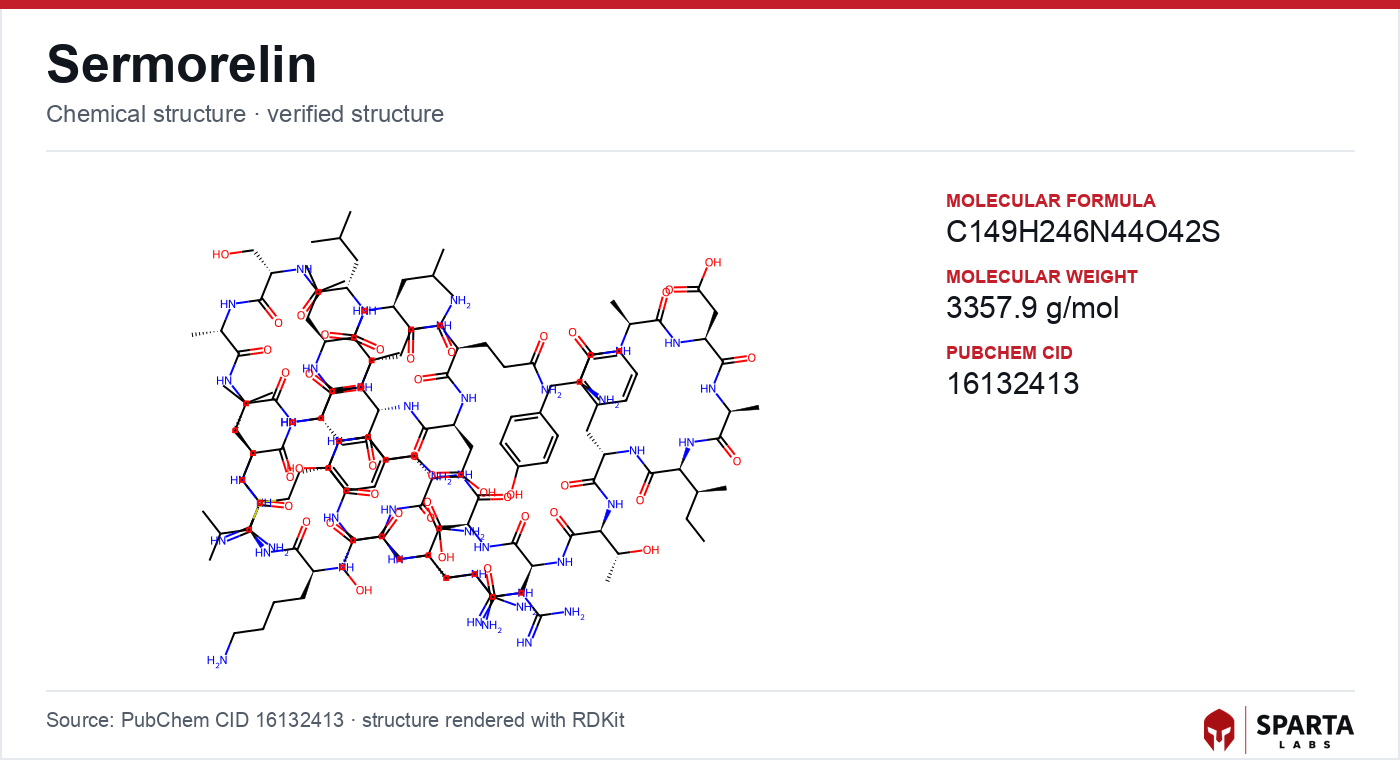
Figure: chemical structure of sermorelin.
Synthesis and Manufacturing
Sermorelin, as a 29-amino-acid peptide, is synthesized using solid-phase peptide synthesis (SPPS), the technique first described by Merrifield in 1963 and recognized with the Nobel Prize in Chemistry in 1984 [1]. SPPS remains the standard for the production of research-grade peptides in the range of roughly 10 to 50 amino acid residues. The method builds the peptide chain sequentially on a solid resin support, with each amino acid coupling step followed by deprotection of the terminal amine, and culminating in cleavage of the completed chain from the resin and global deprotection of side-chain protecting groups.
For a peptide of sermorelin's length, SPPS is conducted using Fmoc (9-fluorenylmethoxycarbonyl) chemistry, which has supplanted the earlier Boc-based approach for most modern peptide synthesis operations. Andersson and colleagues (2000) reviewed large-scale peptide synthesis methodology applicable to research and pharmaceutical-grade production, documenting the coupling efficiencies and purification strategies relevant to peptides in this size class [2].
A distinguishing chemical feature of sermorelin is its C-terminal amide. Whereas standard SPPS on a Wang-type resin yields a peptide with a free C-terminal carboxylic acid, an amidated peptide such as sermorelin is typically assembled on an amide-generating resin (for example, a Rink amide resin) so that cleavage releases the completed chain with the terminal amide already in place. This is a synthesis-design decision that must be specified at the outset of chain assembly, and it is one of the structural details that mass spectrometric release testing is used to confirm, since an amidated and a free-acid form of the same sequence differ by a small, measurable mass increment.
Purity Standards
High-performance liquid chromatography (HPLC) is the analytical standard for measuring peptide purity in research-grade materials. HPLC separates the target peptide from truncated sequences, deletion sequences, oxidized variants, and other synthesis impurities by exploiting differences in hydrophobicity (reversed-phase HPLC) or charge distribution (ion-exchange HPLC). The purity percentage reported on a certificate of analysis reflects the proportion of the total UV-absorbance area attributable to the primary peptide peak.
The industry minimum for research-use peptides is HPLC purity of at least 98 percent [3]. The Sparta Labs internal standard for sermorelin is HPLC purity of at least 98 percent, with each batch additionally subject to mass spectrometric confirmation of molecular identity.
Mass spectrometry (MS), typically electrospray ionization mass spectrometry (ESI-MS) for peptides of sermorelin's size, provides definitive confirmation that the molecular weight of the primary peptide peak corresponds to the theoretical mass of sermorelin, approximately 3,358 daltons. ESI-MS of a peptide in this mass range produces a characteristic charge envelope across multiple charge states; the deconvoluted mass is compared against the theoretical molecular weight to confirm structural identity, including the presence of the C-terminal amide.
One sequence-specific analytical consideration for sermorelin is the presence of a methionine residue, an amino acid whose thioether side chain is susceptible to oxidation. Oxidized methionine variants add a small mass increment relative to the parent peptide and can be resolved chromatographically, so HPLC and MS release testing together serve to detect and quantify any such variant. Residual analysis additionally covers co-purification of synthesis by-products including trifluoroacetic acid (TFA), which is used in the cleavage and deprotection steps of Fmoc SPPS and can persist as a counter-ion salt in the final lyophilized product. Acetic acid counter-ion exchange and endotoxin testing are additional quality parameters for research-grade peptides where the testing protocol calls for these assessments.
Third-Party Verification
Independent laboratory verification is the methodological cornerstone of credible quality claims in the research peptide supply chain. Sparta Labs submits every production batch of sermorelin to an independent third-party analytical laboratory for HPLC purity measurement and ESI-MS molecular weight confirmation. The third-party laboratory operates independently of the Sparta Labs manufacturing and commercial operations; the laboratory's analytical reports are the basis for the purity and identity data appearing on each batch's certificate of analysis.
Third-party testing provides what in-house testing cannot: independence from any commercial incentive to release material that a purely internal assessment might treat as borderline. The analytical rationale is straightforward. HPLC quantifies the primary-peak area against the summed area of synthesis-related impurities, while ESI-MS confirms that the primary species carries the theoretical mass of the intended sequence rather than that of a truncation, deletion, or oxidized variant. Because these two orthogonal methods interrogate purity and identity respectively, an independent laboratory applying both provides a check that neither method alone, and no self-reported figure, can substitute for. The Sparta Labs policy of third-party-first verification is designed so that the purity and identity data published on each COA reflect independent analytical findings.
Certificates of Analysis
Sparta Labs publishes a certificate of analysis (COA) for every production batch of sermorelin. The COA documents:
- HPLC purity: the percentage purity from reversed-phase HPLC analysis, with the chromatographic method specified
- Mass spectrometric confirmation: the observed molecular weight from ESI-MS compared against the theoretical molecular weight of sermorelin (approximately 3,358 Da), confirming molecular identity including the C-terminal amide
- Batch number: a unique identifier linking the material in the vial to the analytical records for that production lot
- Manufacturing date and expiry date: establishing the shelf life of the lyophilized material under specified storage conditions
- Analytical laboratory identification: identifying the third-party laboratory responsible for the HPLC and MS analyses
The COA for any Sparta Labs sermorelin batch is accessible from the product page. Researchers who require the COA before placing an order are encouraged to request it via the product page's documentation link. A general explanation of how to read these documents is available in the guide to COA peptide testing.
Storage and Stability
Lyophilized peptides, including sermorelin, exhibit substantially greater stability than reconstituted solutions. In the lyophilized state, sermorelin should be stored at minus 20 degrees Celsius or below, protected from light and moisture, and kept sealed until required for use. Under these conditions, the peptide's chemical stability is maintained through the expiry date specified on the COA. The reasons peptides are supplied as lyophilized powder rather than in solution are discussed further in the article on why peptides are lyophilized.
General principles for peptide stability in the lyophilized state have been characterized in the published analytical chemistry literature [4]. Lyophilization removes water, the principal solvent for hydrolytic degradation reactions; low-temperature, light-protected storage suppresses residual chemical degradation pathways. For sermorelin specifically, the presence of a methionine residue makes protection from oxidative conditions a particular point of emphasis, since methionine oxidation is one of the more common chemical degradation routes for peptides that contain this residue.
Upon reconstitution, peptide solutions are more susceptible to degradation than lyophilized powder. Reconstituted sermorelin solutions should be stored at 4 degrees Celsius, used within the timeframe specified in the accompanying documentation, and not subjected to repeated freeze-thaw cycling, which accelerates aggregation and chemical degradation [4]. Each reconstitution event should be performed with sterile diluent appropriate for research applications.
Why Sourcing Matters for Research
The reproducibility of peptide pharmacology research depends critically on the chemical consistency of the materials used. Batch-to-batch variability in purity profiles, the presence of synthesis impurities at analytically relevant concentrations, or misidentification of the primary compound each introduce uncontrolled variables into an experiment. Verified purity and confirmed molecular identity are what allow an observed result to be attributed to the intended compound rather than to an unquantified impurity or a degraded fraction, which is why release testing precedes any research use.
For sermorelin research specifically, chemical identity turns on two features that release testing is designed to confirm: the correct 29-residue sequence with its C-terminal amide, and the absence of significant oxidized methionine variants. Material that failed to confirm the terminal amide, or that carried a substantial oxidized fraction, would represent a different analytical entity than the intended peptide. Mass spectrometric and chromatographic confirmation are therefore not formalities but the analytical steps that distinguish verified sermorelin from a misidentified or partially degraded preparation.
Sparta Labs publishes a certificate of analysis with every batch, verifies purity and identity through an independent third-party laboratory, and maintains batch traceability from the COA to the vial. Comparable quality standards for a related growth-hormone-releasing peptide are described in the tesamorelin sourcing and quality article for researchers working across this class. Research-grade sermorelin from Sparta Labs is available with COA documentation on the product page.
References
-
Merrifield RB. Solid phase peptide synthesis. I. The synthesis of a tetrapeptide. J Am Chem Soc. 1963;85(14):2149-54. DOI: 10.1021/ja00897a025
-
Andersson L, Blomberg L, Flegel M, Lepsa L, Nilsson B, Verlander M. Large-scale synthesis of peptides. Biopolymers. 2000;55(3):227-50. PMID: 10880966. DOI: 10.1002/1097-0282(2000)55:3<227::AID-BIP50>3.0.CO;2-7
-
Jaradat DM. Thirteen decades of peptide synthesis: key developments in solid phase peptide synthesis and amide bond formation utilized in peptide ligation. Amino Acids. 2018;50(1):39-68. PMID: 29063202. DOI: 10.1007/s00726-017-2516-0
-
Manning MC, Chou DK, Murphy BM, Payne RW, Katayama DS. Stability of protein pharmaceuticals: an update. Pharm Res. 2010;27(4):544-75. PMID: 20143256. DOI: 10.1007/s11095-009-0045-6
Disclaimer. Statements in this article have not been evaluated by the Food and Drug Administration. This compound is not intended to diagnose, treat, cure, or prevent any disease. Sparta Labs sells research-use-only materials. Content is provided for educational and informational purposes only and does not constitute medical advice. Consult a qualified medical professional for any health concerns.
Frequently asked questions
How is sermorelin synthesized?
Sermorelin is synthesized using solid-phase peptide synthesis (SPPS) with Fmoc chemistry, the standard method for research-grade peptides in the 10 to 50 amino acid range. Because sermorelin carries a C-terminal amide rather than a free carboxylic acid, synthesis typically begins on an amide-generating resin so that the completed 29-residue chain is released with the terminal amide already in place.
What is HPLC purity for sermorelin?
HPLC (high-performance liquid chromatography) purity measures the proportion of the total UV-absorbance area attributable to the primary peptide peak relative to synthesis impurities. The industry minimum for research-use peptides is at least 98 percent, and the Sparta Labs internal standard for sermorelin is also at least 98 percent, with each batch additionally subject to mass spectrometric confirmation of molecular identity.
What is a Certificate of Analysis (COA) for sermorelin?
A COA documents the analytical results for a specific production batch, including HPLC purity percentage, mass spectrometric confirmation of molecular weight against the theoretical mass of sermorelin (approximately 3,358 Da), batch number, manufacturing and expiry dates, and the identity of the third-party laboratory that performed the analyses. Sparta Labs publishes a COA for every production batch.
How should sermorelin be stored?
In the lyophilized state, sermorelin should be stored at minus 20 degrees Celsius or below, protected from light and moisture, and kept sealed until required for use. Once reconstituted, solutions should be stored at 4 degrees Celsius, used within the timeframe specified in accompanying documentation, and not subjected to repeated freeze-thaw cycling.
Why does the methionine residue matter for sermorelin quality?
Sermorelin's sequence contains a methionine residue, an amino acid side chain that is susceptible to oxidation. Analytical release testing by HPLC and mass spectrometry is designed to detect oxidized variants, which is one reason low-temperature, light-protected storage of the lyophilized powder is emphasized for this peptide.