
Sermorelin: A Research Overview
A neutral research overview of sermorelin (GRF 1-29): its chemistry, growth-hormone-releasing-hormone classification, reported mechanism, published research record, and regulatory history. Educational reference.
For research use only. Not for human consumption. This article is educational reference material. It is not medical advice and is not a recommendation to use any substance.
Introduction
Sermorelin is a synthetic 29-amino-acid peptide corresponding to the biologically active N-terminal region of human growth-hormone-releasing hormone (GHRH), and is frequently designated GRF(1-29) in the scientific literature. It is pharmacologically classified as a GHRH-receptor agonist, a category of growth-hormone secretagogue that acts on the anterior pituitary rather than supplying growth hormone directly. Interest in sermorelin as a research compound derives from its role as the shortest synthetic peptide reported to retain the full growth-hormone-releasing activity of the native 44-residue hormone, and from its documented regulatory history as a former FDA-approved diagnostic and pediatric agent. This overview summarizes the published research record on sermorelin: its methodology types, a bibliographic summary of representative studies with attribution, and the principal knowledge gaps that remain open. Readers seeking a structural side-by-side with a related modified analog will find one in the tesamorelin versus sermorelin comparison article.
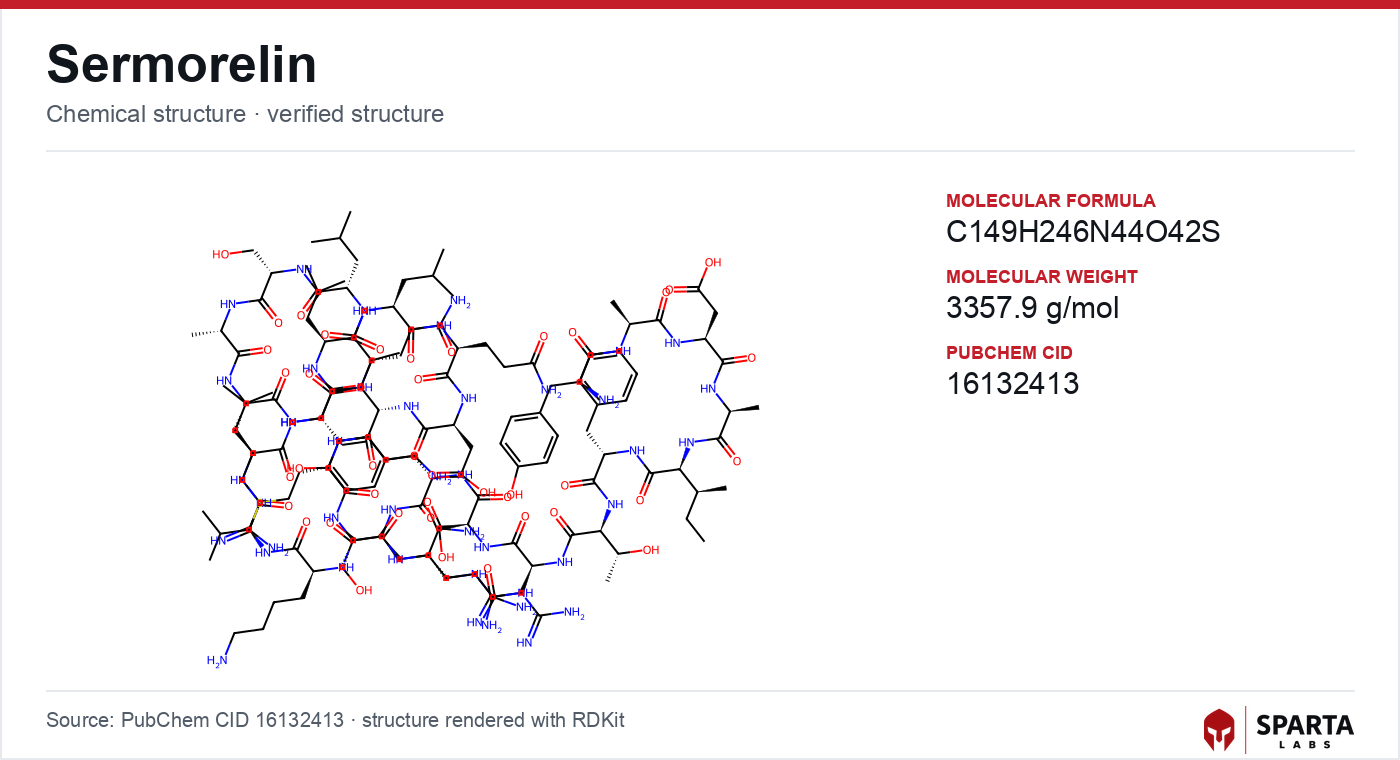
Figure: chemical structure of sermorelin.
Methodology Types in the Published Literature
The published research on sermorelin and its parent peptide spans several distinct study designs. The foundational literature consists of biochemical isolation and characterization work, in which the growth-hormone-releasing factor was purified from tumor tissue, sequenced, and synthetically replicated. A second category comprises pharmacodynamic studies (typically short-duration, controlled investigations in healthy volunteer or clinical cohorts) that measured growth-hormone and insulin-like growth factor-1 (IGF-1) responses following administration of GHRH(1-29). A third category encompasses diagnostic-testing research, in which GHRH-based provocative tests were evaluated for assessing pituitary somatotroph capacity. Finally, narrative and systematic review articles have synthesized the diagnostic and endocrinological literature. The compound's short reported plasma half-life, attributed in the literature to renal ultrafiltration and enzymatic degradation, is a recurring methodological consideration across these study types.
Summary of Published Studies
Guillemin et al., 1982 (Science)
Guillemin and colleagues (1982) reported the isolation, characterization, and synthesis of an amidated 44-amino-acid growth-hormone-releasing factor (designated GRF-44) from a human pancreatic tumor that had caused acromegaly. The authors reported that the synthetic replicate exhibited full biological activity in vitro and in vivo in stimulating the secretion of immunoreactive growth hormone, and that the tumor-derived peptide was similar in physicochemical properties to the hypothalamic growth-hormone-releasing factor that had previously eluded characterization [1]. This work established the parent sequence from which the sermorelin 1-29 fragment is derived.
Findings from research models do not establish safety or efficacy in humans. Sparta Labs makes no claims about the use of this compound.
Corpas et al., 1992 (Journal of Clinical Endocrinology and Metabolism)
Corpas and colleagues (1992) examined the effects of GHRH-(1-29) administration in a controlled study comparing healthy younger men (mean age approximately 26 years) and healthy older men (mean age approximately 68 years). Using a crossover design with an intervening non-treatment interval, the authors reported dose-related increases in mean 24-hour growth-hormone measures, area under secretory peaks, peak amplitude, and IGF-1 concentrations in the older cohort. The authors reported that short-term subcutaneous administration of GHRH-(1-29) to healthy older men was associated with a reversal of age-related decrements in growth-hormone and IGF-1 measures relative to baseline [2]. This study is frequently cited in the pharmacodynamic literature characterizing GHRH-receptor agonism across age groups.
Prakash and Goa, 1999 (BioDrugs)
Prakash and Goa (1999) published a review of sermorelin's reported use in the diagnosis and treatment of children with idiopathic growth hormone deficiency. The authors described sermorelin as a 29-amino-acid analog of human GHRH and summarized the diagnostic literature, characterizing the growth-hormone response to intravenous sermorelin as a relatively rapid and specific assessment of pituitary somatotroph capacity, with the review noting fewer false-positive responses than reported for some other provocative tests [3]. The review also summarized the compound's pharmacological profile, including its short plasma half-life. As a secondary source, this review contextualizes the primary diagnostic and pediatric research rather than reporting new experimental findings.
Aimaretti et al., 2000 (Journal of Clinical Endocrinology and Metabolism)
Aimaretti and colleagues (2000) reported on the use of a GHRH-plus-arginine provocative test to re-evaluate young adults with childhood-onset growth hormone deficiency. The authors examined whether the combined test could distinguish persistent deficiency from normalized secretion at the transition to adulthood, contributing to the diagnostic-testing literature that underpins GHRH-based somatotroph-capacity assessment [4]. This line of research illustrates the broader diagnostic context in which GHRH-analog peptides, including sermorelin, have been investigated.
Walker, 2006 (Clinical Interventions in Aging)
Walker (2006) authored an editorial and review examining GHRH-based approaches, including sermorelin, in the context of adult-onset growth-hormone insufficiency research. The article discussed the pharmacological rationale for stimulating endogenous growth-hormone secretion via the GHRH receptor as distinct from exogenous recombinant growth-hormone administration, and it reviewed the limited controlled-study base available for long-term characterization [5]. The article is a secondary source that frames open research questions rather than reporting a primary trial.
Chemistry, Classification, and Regulatory Context
Sermorelin is described in the literature as an amidated 29-residue peptide replicating positions 1 through 29 of the native GHRH(1-44) sequence. Its pharmacological classification is that of a GHRH-receptor agonist within the broader growth-hormone-secretagogue category; this places it in a mechanistic family distinct from the ghrelin-receptor secretagogues, whose published research is summarized in the GHRP-2 published research article. Detailed molecular-interaction reporting for GHRH-receptor agonism is covered in the CJC-1295 mechanism of action article, which discusses a related GHRH-analog family. Research-grade tesamorelin from Sparta Labs, a modified GHRH analog in the same receptor-agonist classification, is supplied as a research-use-only material.
On the regulatory record, sermorelin acetate was marketed under the trade name GEREF. A 2013 Federal Register determination documents that the 0.05 mg ampule was approved as a diagnostic agent for evaluating pituitary somatotroph growth-hormone-secreting capacity, and that the 0.5 mg and 1.0 mg vials were later approved for idiopathic growth hormone deficiency in children with growth failure. The same notice records that the manufacturer discontinued the products in 2008 and that the FDA determined GEREF was not withdrawn from sale for reasons of safety or effectiveness [6]. Sermorelin currently holds no active FDA marketing approval and is handled as a research-use-only material. Research-grade sermorelin from Sparta Labs is characterized by independent third-party analysis.
Knowledge Gaps
Several areas remain open in the published sermorelin literature. The short reported plasma half-life of the unmodified 1-29 fragment is a recurring theme, and much of the peptide-engineering literature has focused on stabilized GHRH analogs; the comparative pharmacokinetics of sermorelin against modified analogs such as those discussed in the tesamorelin published research article continue to be characterized. The diagnostic-testing literature is more mature than the long-term interventional literature, and controlled long-duration studies of GHRH-receptor agonism outside the pediatric and diagnostic settings are comparatively limited. Finally, the molecular determinants of receptor selectivity, downstream signaling kinetics, and the relative contributions of direct pituitary action versus systemic IGF-1 feedback remain active subjects of investigation across the GHRH-analog class. Consistent with the "cite, don't claim" standard, this overview reports what the primary and review literature has documented and does not extend those findings beyond their published scope.
References
-
Guillemin R, Brazeau P, Böhlen P, Esch F, Ling N, Wehrenberg WB. Growth hormone-releasing factor from a human pancreatic tumor that caused acromegaly. Science. 1982;218(4572):585-7. PMID: 6812220. DOI: 10.1126/science.6812220
-
Corpas E, Harman SM, Piñeyro MA, Roberson R, Blackman MR. Growth hormone (GH)-releasing hormone-(1-29) twice daily reverses the decreased GH and insulin-like growth factor-I levels in old men. J Clin Endocrinol Metab. 1992;75(2):530-5. PMID: 1379256. DOI: 10.1210/jcem.75.2.1379256
-
Prakash A, Goa KL. Sermorelin: a review of its use in the diagnosis and treatment of children with idiopathic growth hormone deficiency. BioDrugs. 1999;12(2):139-57. PMID: 18031173. DOI: 10.2165/00063030-199912020-00007
-
Aimaretti G, Baffoni C, Bellone S, Di Vito L, Corneli G, Arvat E, et al. Retesting young adults with childhood-onset growth hormone (GH) deficiency with GH-releasing-hormone-plus-arginine test. J Clin Endocrinol Metab. 2000;85(10):3693-9. PMID: 11061526. DOI: 10.1210/jcem.85.10.6825
-
Walker RF. Sermorelin: a better approach to management of adult-onset growth hormone insufficiency? Clin Interv Aging. 2006;1(4):307-14. PMID: 18046908. Available at: https://pmc.ncbi.nlm.nih.gov/articles/PMC2699646/
-
Food and Drug Administration. Determination That GEREF (Sermorelin Acetate) Injection, 0.5 Milligrams Base/Vial and 1.0 Milligrams Base/Vial, and GEREF (Sermorelin Acetate) Injection, 0.05 Milligrams Base/Amp, Were Not Withdrawn From Sale for Reasons of Safety or Effectiveness. Federal Register. 2013 Mar 4;78(42):14063-4. Available at: https://www.federalregister.gov/documents/2013/03/04/2013-04827
Disclaimer. Statements in this article have not been evaluated by the Food and Drug Administration. This compound is not intended to diagnose, treat, cure, or prevent any disease. Sparta Labs sells research-use-only materials. Content is provided for educational and informational purposes only and does not constitute medical advice. Consult a qualified medical professional for any health concerns.
Frequently asked questions
What is sermorelin?
Sermorelin is a synthetic 29-amino-acid peptide that corresponds to the biologically active N-terminal fragment of human growth-hormone-releasing hormone (GHRH). Published literature classifies it as a GHRH analog, and it is studied in research contexts as a reference for GHRH-related investigation.
What is sermorelin peptide?
Sermorelin is a peptide, meaning a short chain of amino acids linked by peptide bonds. It consists of 29 amino acids representing the N-terminal segment of endogenous GHRH, the portion the scientific literature identifies as the minimum sequence retaining GHRH activity.
Is sermorelin a peptide?
Yes. Sermorelin is a peptide composed of 29 amino acids. In the published literature it is described as a growth-hormone-releasing hormone (GHRH) analog corresponding to the N-terminal fragment of the naturally occurring 44-amino-acid GHRH molecule.
Is sermorelin a steroid?
No. Sermorelin is not a steroid. It is a peptide, a chain of amino acids, and belongs to a chemically distinct class from steroids, which are lipid-based molecules built on a four-ring carbon structure. The literature classifies sermorelin as a GHRH analog.
Is sermorelin FDA approved?
Sermorelin acetate was previously FDA-approved under the brand name Geref for use in certain diagnostic and pediatric growth contexts, but the manufacturer discontinued it and it was withdrawn from the U.S. market. It is currently sold only as a research-use-only material, not an approved drug.
What is sermorelin used for in research?
In the published record, sermorelin has been studied as a growth-hormone-releasing hormone analog used to investigate GHRH receptor activity and the pituitary growth-hormone axis. Historically it was also studied as a diagnostic agent for evaluating pituitary function, as described in the clinical literature.