
Sermorelin Mechanism of Action
A research-focused examination of sermorelin's reported mechanism as a GHRH(1-29) analog: GHRH receptor binding, the Gs-cAMP-PKA-CREB signaling cascade in pituitary somatotrophs, and the molecular basis of its short peptide lifetime. Educational reference.
For research use only. Not for human consumption. This article is educational reference material. It is not medical advice and is not a recommendation to use any substance.
Introduction
Sermorelin is a synthetic peptide corresponding to the first 29 amino acids of human growth hormone-releasing hormone (GHRH), presented as a C-terminal amide, and is commonly designated GHRH(1-29)NH2 or GRF(1-29)NH2. Pharmacologically it is classified as a GHRH receptor agonist within the broader growth hormone secretagogue category. This article summarizes the reported molecular mechanism of sermorelin as documented in peer-reviewed primary literature and receptor-pharmacology reviews, with attribution to the relevant sources. It is confined to the molecular level: receptor identity, binding determinants, intracellular signal transduction, and the enzymatic chemistry that governs the peptide's molecular lifetime.
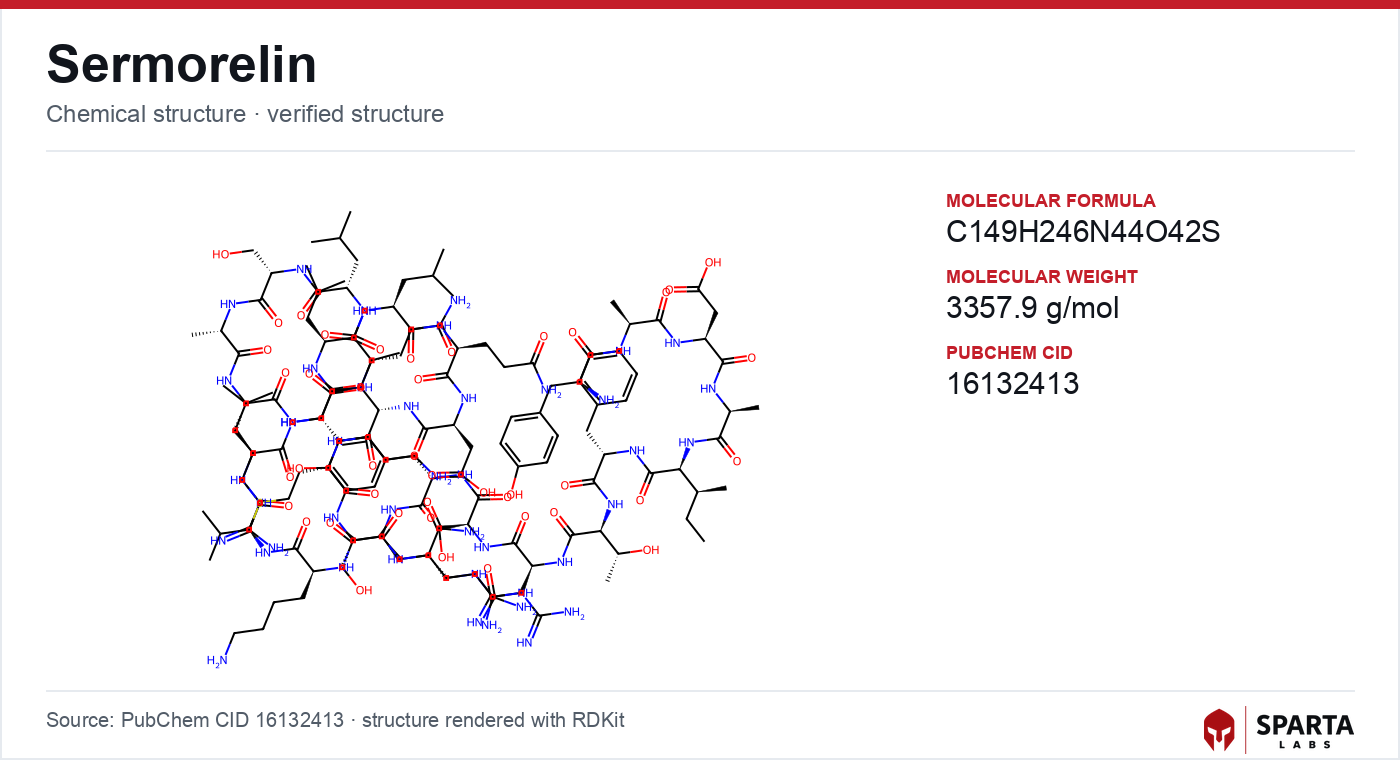
Figure: chemical structure of sermorelin.
Receptor Target and Pathway
The reported molecular target of sermorelin is the growth hormone-releasing hormone receptor (GHRH-R), also designated GHRHR. Mayo cloned and expressed a pituitary-specific receptor for GHRH in 1992, reporting that the encoded protein contained seven potential membrane-spanning domains characteristic of G protein-coupled receptors and that it bound human GHRH with high affinity and specificity [1]. The receptor was reported to be homologous to the receptors for secretin and vasoactive intestinal peptide, placing it within the class B (secretin-like) family of G protein-coupled receptors.
Findings from research models do not establish safety or efficacy in humans. Sparta Labs makes no claims about the use of this compound.
A 2025 review of GHRH-R and its signaling in Reviews in Endocrine and Metabolic Disorders summarized the structural and functional evidence for the receptor, describing its predominant expression on anterior pituitary somatotroph cells and its role as the canonical upstream regulator of somatotroph activity [2]. The GHRH-R is distinct from the ghrelin receptor (GHS-R1a) that mediates the actions of the growth hormone-releasing peptides such as the hexapeptides; sermorelin engages the GHRH-R rather than the ghrelin receptor. The mechanistic distinction between these two receptor systems is discussed further in the sermorelin research overview article.
Reported Molecular Interactions
The molecular rationale for sermorelin's 29-residue length is grounded in structure-activity studies of the native 44-amino-acid GHRH peptide. Lance and colleagues (1984) reported that the biological activity of growth hormone-releasing factor resides in the N-terminal portion of the molecule and examined GRF(1-29)NH2 analogs with substitutions at the first three positions, characterizing how N-terminal residues govern intrinsic activity in their assay systems [3]. Cervini and colleagues (1998) subsequently performed systematic alanine-scanning and substitution studies across hGHRH(1-29)-NH2, reporting near-complete loss of potency when residues at positions 1, 3, 5, and 6 were replaced, which identified the extreme N-terminus as a functionally essential receptor-binding domain [4].
Upon binding to the GHRH-R, the receptor is reported to couple to a stimulatory G protein (Gs), whose alpha subunit activates adenylyl cyclase. The 2025 GHRH-R signaling review describes the resulting accumulation of intracellular cyclic adenosine monophosphate (cAMP) as the principal second-messenger event, followed by activation of protein kinase A (PKA) [2]. Because sermorelin reproduces the receptor-binding N-terminal sequence of native GHRH, the receptor-level interactions reported for GHRH itself provide the mechanistic model applied to the truncated analog. This canonical Gs-cAMP coupling is the same pathway described for the full-length GHRH analog tesamorelin, which retains all 44 residues of GHRH with a stabilizing N-terminal modification. Identity and purity documentation for tesamorelin from Sparta Labs is available on that compound's product page.
Downstream Molecular Effects
The reported downstream consequence of PKA activation is phosphorylation of the transcription factor CREB (cAMP response element-binding protein). The 2025 review describes phosphorylated CREB, together with the coactivators p300 and CREB-binding protein, binding cAMP response elements in the promoter region of the growth hormone gene and coupling receptor occupancy to transcriptional regulation [2]. The review further notes that CREB activity has been linked to expression of the pituitary-specific transcription factor Pit-1, providing a reported molecular route by which receptor signaling connects to somatotroph gene expression [2].
This cascade (receptor occupancy, Gs activation, adenylyl cyclase stimulation, cAMP accumulation, PKA activation, and CREB phosphorylation) constitutes the reported signal-transduction sequence for GHRH-R agonists at the somatotroph. The molecular events described here are receptor and second-messenger phenomena; they are not represented as clinical outcomes. Comparative molecular framing of sermorelin against other GHRH-derived analogs is discussed in the tesamorelin versus sermorelin comparison article.
Molecular Stability and Enzymatic Degradation
A defining molecular feature of sermorelin's pharmacology is its susceptibility to enzymatic cleavage. Published enzymology reported that GRF(1-29)NH2 is a substrate for dipeptidyl peptidase IV (DPP-IV), a serine peptidase that removes N-terminal dipeptides from substrates bearing an alanine or proline at the second position [5]. The GRF(1-29)NH2 sequence begins with Tyr1-Ala2, matching the DPP-IV recognition motif; cleavage of this dipeptide was reported to generate GRF(3-29)NH2 as the major metabolite in brush-border membrane preparations [5].
Because the structure-activity data identify the intact N-terminus as essential for receptor engagement [4], removal of the first two residues is described in the literature as an inactivating modification. This enzymatic chemistry is the molecular explanation most frequently cited for the short reported persistence of unmodified GHRH(1-29) peptides, and it is the same cleavage site that longer-acting GHRH analogs are engineered to resist: a design strategy detailed for the modified analog family in the CJC-1295 mechanism of action article. Researchers evaluating identity and purity specifications can review the analytical documentation for sermorelin from Sparta Labs on the product page.
Limits of Current Understanding
Several aspects of GHRH-R molecular pharmacology remain under characterization in the published literature. The 2025 signaling review notes that, beyond the predominant Gs-cAMP-PKA arm, secondary signaling routes, including calcium-dependent and mitogen-activated protein kinase (MAPK) cascades, have been reported for the GHRH receptor, and the quantitative contribution of these secondary arms relative to the canonical cAMP pathway continues to be investigated [2]. The receptor's reported expression at extrapituitary sites and the molecular consequences of GHRH-R signaling in those tissues likewise represent active research frontiers rather than settled mechanism.
The mechanistic model applied to sermorelin is derived largely from studies of native GHRH and of the receptor itself, on the basis that sermorelin reproduces the receptor-binding N-terminal sequence [3][4]. Direct molecular characterization specific to the truncated analog, versus inference from the parent peptide, remains a distinction worth preserving in any rigorous reading of the primary literature.
References
-
Mayo KE. Molecular cloning and expression of a pituitary-specific receptor for growth hormone-releasing hormone. Mol Endocrinol. 1992;6(10):1734-44. PMID: 1333056. DOI: 10.1210/mend.6.10.1333056. https://pubmed.ncbi.nlm.nih.gov/1333056/
-
Siejka A, Barabutis N. Growth hormone-releasing hormone receptor (GHRH-R) and its signaling. Rev Endocr Metab Disord. 2025;26(2):271-284. PMID: 39934495. DOI: 10.1007/s11154-025-09952-x. https://www.ncbi.nlm.nih.gov/pmc/articles/PMC12137518/
-
Lance VA, Murphy WA, Sueiras-Diaz J, Coy DH. Super-active analogs of growth hormone-releasing factor (1-29)-amide. Biochem Biophys Res Commun. 1984;119(1):265-72. PMID: 6324752. DOI: 10.1016/0006-291x(84)91647-6. https://pubmed.ncbi.nlm.nih.gov/6324752/
-
Cervini LA, Donaldson CJ, Koerber SC, Vale WW, Rivier JE. Human growth hormone-releasing hormone hGHRH(1-29)-NH2: systematic structure-activity relationship studies. J Med Chem. 1998;41(5):717-27. PMID: 9513600. DOI: 10.1021/jm970618s. https://pubmed.ncbi.nlm.nih.gov/9513600/
-
Frohman LA, Downs TR, Heimer EP, Felix AM. Dipeptidylpeptidase IV and trypsin-like enzymatic degradation of human growth hormone-releasing hormone in plasma. J Pharm Pharmacol. 1995;47(8):698-701. PMID: 8583376. DOI: 10.1111/j.2042-7158.1995.tb05863.x. https://pubmed.ncbi.nlm.nih.gov/8583376/
Disclaimer. Statements in this article have not been evaluated by the Food and Drug Administration. This compound is not intended to diagnose, treat, cure, or prevent any disease. Sparta Labs sells research-use-only materials. Content is provided for educational and informational purposes only and does not constitute medical advice. Consult a qualified medical professional for any health concerns.
Frequently asked questions
How does sermorelin work at the molecular level?
Sermorelin corresponds to the N-terminal 1-29 fragment of human growth hormone-releasing hormone and acts as an agonist at the GHRH receptor on anterior pituitary somatotroph cells. Published receptor pharmacology reports that occupancy of this Gs-coupled receptor activates adenylyl cyclase, raising intracellular cyclic AMP and activating protein kinase A. This cascade is the reported basis for the receptor's coupling to growth hormone synthesis and release.
What receptor does sermorelin target?
Sermorelin's molecular target is the growth hormone-releasing hormone receptor (GHRH-R), a class B G protein-coupled receptor cloned from pituitary tissue by Mayo in 1992. The receptor is expressed predominantly on anterior pituitary somatotrophs and is distinct from the ghrelin/GHS-R1a receptor engaged by growth hormone-releasing peptides.
Why is the sermorelin sequence only 29 amino acids?
Structure-activity studies reported that the receptor-binding and intrinsic-activity determinants of the 44-residue native GHRH molecule reside in its N-terminal region. Lance and colleagues (1984) and later Cervini and colleagues (1998) reported that the GHRH(1-29) amide fragment retained full intrinsic activity in their assay systems, which is the molecular rationale for sermorelin's truncated sequence.
What limits sermorelin's molecular lifetime?
Published enzymology reported that GRF(1-29)NH2 is a substrate for dipeptidyl peptidase IV (DPP-IV), which cleaves the N-terminal Tyr1-Ala2 dipeptide to yield the GRF(3-29)NH2 fragment. Because the intact N-terminus is required for receptor activation, this cleavage is described in the literature as an inactivating event, and it is the molecular explanation most often cited for the peptide's short reported plasma persistence.